Rubik’s Cube Notation for Kids: Easy Visual Chart, Drills and Cheat Sheet
Quick answer: The easiest way to explain Rubik’s Cube notation for kids: it’s a simple letter code for turning the cube. The six letters are R (right), L (left), U (up, the top), D (down, the bottom), F (front) and B (back). A letter by itself means turn that face a quarter turn clockwise, as if you were looking right at it. A letter with a ‘ (say “prime”) means counterclockwise, and a letter with a 2 means a half turn. So R U R' U' means: right up, top left, right down, top right.
Every cube tutorial and pattern list uses this code, so once kids can read it they can follow any guide without a video. This guide teaches the letters with picture diagrams, gives seven practice drills that each loop back to a solved cube (so mistakes are easy to spot), and ends with a printable cheat sheet for the desk or backpack. We checked every diagram and every “repeat to solve” number on this page with a computer model of a 3×3 cube.
Key takeaways
- Six letters, one per face: R, L, U, D, F, B.
- Plain letter = clockwise quarter turn. Prime (‘) = counterclockwise. 2 = half turn.
- Always judge “clockwise” while imagining you’re looking straight at that face. That’s why L turns the opposite way from R.
- Hold the cube with white on top and green in front, the same starting position the World Cube Association uses for scrambling.
R U R' U'done six times in a row brings a solved cube back to solved. It’s a perfect self-checking drill.
Contents
- The six face letters
- Clockwise, prime and 2
- Visual chart: what each move does
- Bonus letters: x, y, z, M and lowercase
- 7 practice drills that check themselves
- Printable notation cheat sheet
- Common notation mistakes
- How to teach notation to kids
- FAQ
The Six Face Letters
Hold the cube so one face points at you. That’s the front, and every other face is named by where it sits compared with you. These letters come from the official notation in Article 12 of the WCA Regulations, so they work in every guide you’ll find.
| Letter | Face | Where it is | Memory trick |
|---|---|---|---|
| R | Right | The side under your right hand | R for the hand you write with (if you’re right-handed) |
| L | Left | The side under your left hand | Make an “L” with your left thumb and finger |
| U | Up | The top | U for “up to the sky” |
| D | Down | The bottom, touching the table | D for “down to the ground” |
| F | Front | The face looking at you | F for “face to face” |
| B | Back | The face looking away from you | B for “behind” |
Why U and D instead of “top” and “bottom”? Because B is already taken by Back.
Clockwise, Prime and 2: The Three Ways to Turn
Each letter can come in three versions. Here’s the trick that makes all of them easy: pretend you are standing in front of the face you’re turning, looking right at it. Then “clockwise” means the way the hands of a clock move.
| You see | Say it | What to do |
|---|---|---|
| R | “R” | Quarter turn (90°) clockwise |
| R’ | “R prime” | Quarter turn counterclockwise, the undo of R |
| R2 | “R two” | Half turn (180°), either direction |
The “look at the face” rule explains the two moves that confuse kids most. L turns the opposite way from R, because the left face looks at you from the other side. And B looks backwards from the front: B is clockwise as seen from behind the cube, which looks counterclockwise while you hold it.
Visual Chart: What Each Move Does
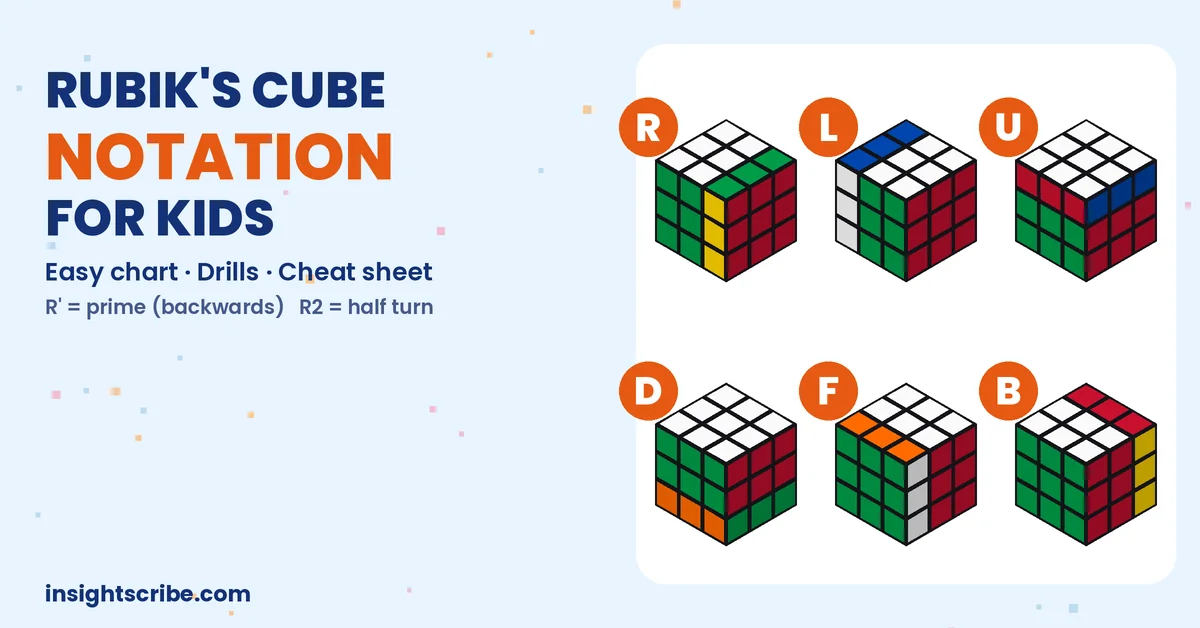
Start with a solved cube, white on top and green in front, and do one move. Your cube should match the picture. Each diagram shows the three faces you can see: top, front and right. Undo it (add or remove the prime) before the next one.
R
Do it: R on a solved cube. The right layer turns up, away from you. The front’s right column climbs to the top.
| Top (U) | Front (F) | Right (R) |
|---|---|---|
| ⬜⬜🟩 ⬜⬜🟩 ⬜⬜🟩 | 🟩🟩🟨 🟩🟩🟨 🟩🟩🟨 | 🟥🟥🟥 🟥🟥🟥 🟥🟥🟥 |
R’
Do it: R' on a solved cube. The right layer turns down, toward you. It’s the exact opposite of R.
| Top (U) | Front (F) | Right (R) |
|---|---|---|
| ⬜⬜🟦 ⬜⬜🟦 ⬜⬜🟦 | 🟩🟩⬜ 🟩🟩⬜ 🟩🟩⬜ | 🟥🟥🟥 🟥🟥🟥 🟥🟥🟥 |
L
Do it: L on a solved cube. The left layer turns down, toward you. Yes, that’s the opposite way from R, because you look at the left face from the left side.
| Top (U) | Front (F) | Right (R) |
|---|---|---|
| 🟦⬜⬜ 🟦⬜⬜ 🟦⬜⬜ | ⬜🟩🟩 ⬜🟩🟩 ⬜🟩🟩 | 🟥🟥🟥 🟥🟥🟥 🟥🟥🟥 |
U
Do it: U on a solved cube. The top layer turns so the front stickers slide to the left.
| Top (U) | Front (F) | Right (R) |
|---|---|---|
| ⬜⬜⬜ ⬜⬜⬜ ⬜⬜⬜ | 🟥🟥🟥 🟩🟩🟩 🟩🟩🟩 | 🟦🟦🟦 🟥🟥🟥 🟥🟥🟥 |
D
Do it: D on a solved cube. The bottom layer turns so the front stickers slide to the right, the opposite of U.
| Top (U) | Front (F) | Right (R) |
|---|---|---|
| ⬜⬜⬜ ⬜⬜⬜ ⬜⬜⬜ | 🟩🟩🟩 🟩🟩🟩 🟧🟧🟧 | 🟥🟥🟥 🟥🟥🟥 🟩🟩🟩 |
F
Do it: F on a solved cube. The front face turns clockwise, like a clock hand, while you look straight at it.
| Top (U) | Front (F) | Right (R) |
|---|---|---|
| ⬜⬜⬜ ⬜⬜⬜ 🟧🟧🟧 | 🟩🟩🟩 🟩🟩🟩 🟩🟩🟩 | ⬜🟥🟥 ⬜🟥🟥 ⬜🟥🟥 |
B
Do it: B on a solved cube. The back face turns clockwise as seen from behind. From the front, it looks counterclockwise.
| Top (U) | Front (F) | Right (R) |
|---|---|---|
| 🟥🟥🟥 ⬜⬜⬜ ⬜⬜⬜ | 🟩🟩🟩 🟩🟩🟩 🟩🟩🟩 | 🟥🟥🟨 🟥🟥🟨 🟥🟥🟨 |
Spot the pattern? Opposite faces (R and L, U and D, F and B) turn opposite ways when you watch from the front.
Bonus Letters You May See: x, y, z, M and Lowercase
- x, y, z mean turn the whole cube in your hands. x turns it the same way as R, y the same way as U, and z the same way as F. Nothing gets mixed up; you just hold it differently.
- Rw or r (wide moves) mean turn the right face together with the middle layer next to it, so two layers move at once. The WCA writes this as Rw.
- M, E and S are the middle slices. M sits between L and R and turns the same way as L. E sits between U and D and turns like D. S sits between F and B and turns like F. They are common in tutorials but aren’t in the WCA’s official notation list.
7 Practice Drills That Check Themselves
Each drill starts from a solved cube and returns to solved after a set number of repeats. If your cube isn’t solved at the end, one move went the wrong way. Say each move out loud as you turn.
1. Four-turn loop
Moves: R R R R. Four quarter turns bring a face back home. Try it with U and F too. R R is the same as R2.
2. Half-turn stripes
Moves: R2 L2. Two half turns paint stripes down four sides. Do it again to undo it.
3. Six-side checkerboard
Moves: R2 L2 U2 D2 F2 B2. Every face becomes a checkerboard. Half turns only, so the direction can’t go wrong.
4. The six-time loop
Moves: R U R' U'. A famous four-move practice set. Six rounds in a row bring the cube back to solved.
5. Lefty loop
Moves: L' U' L U. The mirror of the six-time loop for your left hand. It also returns to solved after six rounds.
6. Hammer loop
Moves: R' F R F'. A trickier set because it uses the front face. Six rounds bring it back.
7. Half-turn zigzag
Moves: R2 U2. Two half turns that make a surprising mess, then return after six rounds.
Challenge for older kids: the two-move sequence R U only comes back to solved after 105 repeats in a row, which is 210 turns. Our computer model confirms it. It’s a great surprise for a math trivia round, but only try it on a cube if you have a lot of patience.
Printable Rubik’s Cube Notation Cheat Sheet
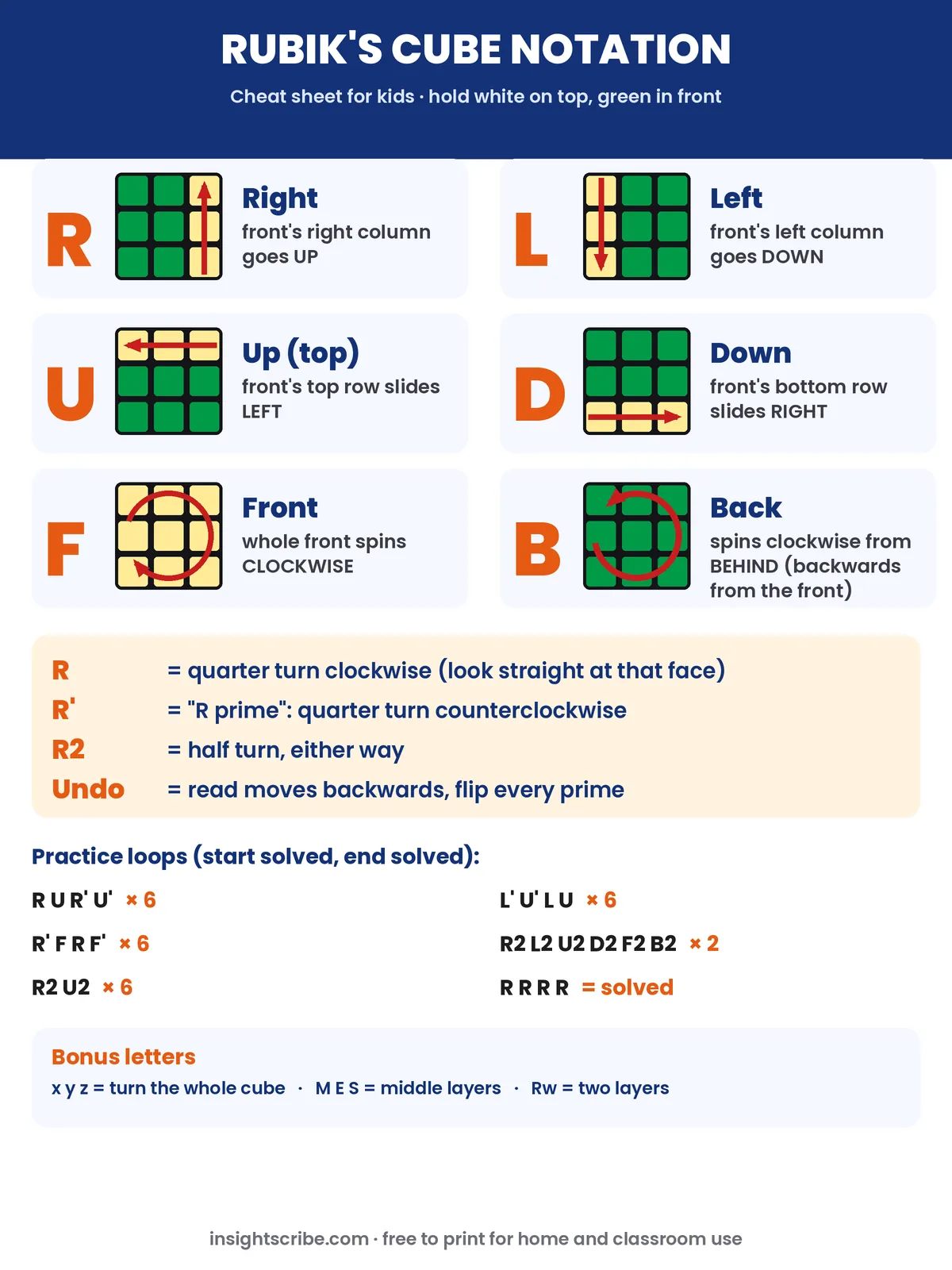
Print the chart below and tape it next to your cube, or slide it into a sheet protector for a classroom cube station.
| Move | Face | Front stickers move… | Undo with |
|---|---|---|---|
| R | Right | Up (right column) | R’ |
| L | Left | Down (left column) | L’ |
| U | Top | Left (top row) | U’ |
| D | Bottom | Right (bottom row) | D’ |
| F | Front | Spin clockwise | F’ |
| B | Back | Front doesn’t move; back spins counterclockwise as you see it | B’ |
| Any letter + ‘ | Same face | The opposite way | The plain letter |
| Any letter + 2 | Same face | Half turn | The same move again |
Undo rule: to undo a whole sequence, read it backwards and flip every prime. The undo of R U F is F' U' R'.
Drills to practice: R R R R ×4; R2 L2 ×2; R2 L2 U2 D2 F2 B2 ×2; R U R' U' ×6; L' U' L U ×6; R' F R F' ×6; R2 U2 ×6.
Common Rubik’s Cube Notation Mistakes
- Turning L like R. L moves the front’s left column down, not up. Picture yourself looking at the left face.
- Turning B the wrong way. B is clockwise from behind. Peek around the back the first few times.
- Turning the whole cube by accident. If the centers change place, you rotated the cube, not a face. Keep white on top and green in front.
- Missing a prime. The little ‘ is easy to skip when reading fast. Slow down and say “prime” out loud.
- Starting from a mixed cube. Drills and patterns only show the right picture if you start solved.
How to Teach Notation to Kids (Quick Plan)
- Name the faces (5 minutes). Point and call out “Up! Front! Right!” like Simon Says until every kid knows the six names.
- Half turns first (5 minutes). R2, U2 and F2 can’t go the wrong way, so early wins come fast. Try the six-side checkerboard.
- Add clockwise and prime (10 minutes). Do one move, check it against the chart, then undo it.
- Loop drills (10 minutes). Finish with the six-time loop. A solved cube at the end is the reward.
Ready to use your new skill? Our easy Rubik’s Cube patterns are written in this same notation, and kids can test what they learned with our Rubik’s Cube trivia questions. You’ll find every cube guide in our Rubik’s puzzles collection.
Rubik’s Cube Notation FAQ
What does R mean on a Rubik’s Cube?
R means turn the right face a quarter turn clockwise, as if you were looking straight at the right side. With the cube in front of you, the front stickers on the right side move up toward the top.
What does the ‘ (prime) mean in cube notation?
The small mark after a letter is called prime. It means turn that face counterclockwise instead of clockwise. So R’ is the opposite of R, and doing R then R’ puts the cube back the way it was.
What does the 2 mean, like R2 or U2?
The 2 means a half turn (180 degrees). Turn the face twice in the same direction. It doesn’t matter which way you go, because two quarter turns either way land in the same spot.
What age can kids learn Rubik’s Cube notation?
Many kids can learn it once they can tell left from right and read single letters, often around age 7 or 8. Younger kids can start with half turns like R2, which can’t go the wrong way.
Does R2 count as one move or two?
In the move count the World Cube Association uses for competitions (the Outer Block Turn Metric), R2 counts as one move. Some people count it as two quarter turns, so always check which way a guide counts.