Brazil Facts for Kids: Amazon, Geography & Wildlife
Brazil is the largest country in South America, home to the Amazon Rainforest, a long Atlantic coastline and more than 214 million people. These Brazil facts for kids focus on geography, population, nature, symbols and history using current IBGE and Brazilian government sources.
Explore more country pages in our Geography Facts for Kids hub.
Quick Brazil Facts for Kids
- Brazil is in South America. It covers a huge part of the continent and has a long coastline on the Atlantic Ocean.
- Brasília is the capital of Brazil. It became the national capital in 1960.
- Portuguese is the official language. Brazil is the only country in South America where Portuguese is the national language.
- Brazil is officially called the Federative Republic of Brazil. It is a federal republic made up of states, municipalities and the Federal District.
- Brazil has 26 states and one Federal District. Brasília is located in the Federal District.
- IBGE estimated Brazil’s population at about 214.2 million on July 1, 2026. Population figures change, so this fact is dated on purpose.
- Brazil covers about 8.51 million square kilometres. It is the largest country in South America by area.
- The Brazilian real is the national currency. Its currency code is BRL.
Geography Facts About Brazil
- Brazil borders almost every South American country. The only South American countries it does not border are Chile and Ecuador.
- The Amazon River flows through northern Brazil. It is one of the world’s largest river systems by water volume.
- Much of the Amazon Rainforest lies inside Brazil. The forest stretches across several South American countries, but Brazil contains the largest share.
- Pico da Neblina is the highest mountain in Brazil. It stands in the north near the border with Venezuela.
- The Pantanal is one of the world’s largest tropical wetland areas. Much of it lies in western Brazil.
- Brazil has five official geographic regions. They are North, Northeast, Central-West, Southeast and South.
- São Paulo is Brazil’s largest city by population. Brasília is the capital, but São Paulo is the country’s biggest urban centre.
Nature and Wildlife Facts
- Brazil is one of the most biodiverse countries on Earth. Its forests, wetlands, grasslands and coastal habitats support an enormous variety of plants and animals.
- Jaguars live in Brazil. They can be found in habitats including the Amazon and Pantanal.
- Brazil is home to giant anteaters, capybaras, macaws and many monkey species. Different animals are adapted to different Brazilian ecosystems.
- The Amazon Rainforest helps move huge amounts of water through the atmosphere. Forest moisture plays an important role in regional rainfall patterns.
- The Pantanal is especially famous for wildlife watching. Seasonal flooding creates rich habitats for birds, mammals, reptiles and fish.
Flag and National Symbols
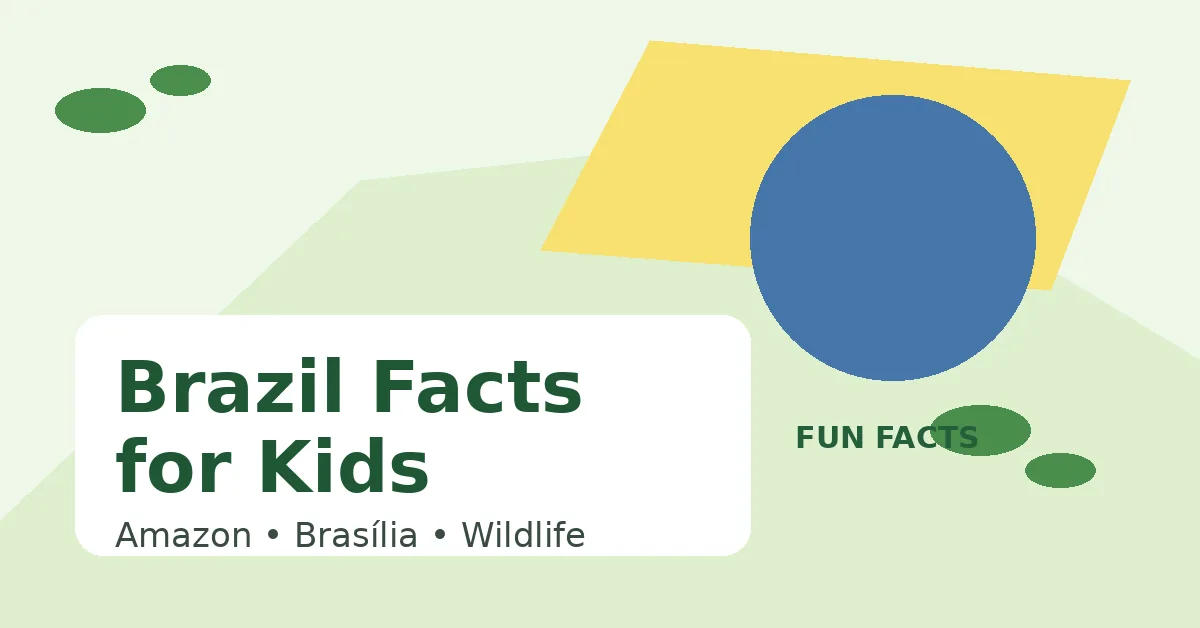
- Brazil’s flag is green with a yellow diamond and a blue globe. A white band across the globe carries the words “Ordem e Progresso,” meaning “Order and Progress.”
- The current flag design dates from the beginning of the republic in 1889. It was approved shortly after the monarchy ended.
- The Brazilian flag has 27 stars. Each star represents one state or the Federal District.
- The stars are arranged to represent constellations. The design is linked to the sky over Rio de Janeiro at the time the republic was proclaimed.
- Green and yellow were kept from Brazil’s earlier imperial flag. They remained part of the national design after the republic was created.
History Facts for Kids
- Indigenous peoples lived in the lands now called Brazil long before Europeans arrived. Brazil still has many Indigenous peoples, languages and cultures.
- Portugal began colonising Brazil in the 1500s. Portuguese rule shaped the country’s language and many institutions.
- Brazil declared independence from Portugal in 1822. September 7 is celebrated as Brazil’s Independence Day.
- Brazil became a republic in 1889. The change ended the Brazilian monarchy.
- Brasília was inaugurated as the capital on April 21, 1960. The planned city moved the national capital inland from Rio de Janeiro.
Why Brazil Is Interesting to Study
Brazil combines huge river systems, tropical rainforest, wetlands, major cities and a long Atlantic coastline. It is useful for geography lessons because students can study ecosystems, population, language, federal government, Indigenous cultures and South American geography in one country.
How We Check Brazil Facts
InsightScribe checks changing statistics against current official sources rather than relying on older fact lists. Population, area and capital data are checked against IBGE. Flag and constitutional facts are checked against Brazilian government sources, while historical dates are cross-checked with official government records.
Continue with Canada Facts for Kids, United States Facts for Kids, or return to Geography Facts for Kids.
Trusted Sources
- IBGE — Brazil: Cities and States
- IBGE — 2026 Population Estimate
- Brazil Ministry of Foreign Affairs — Brazilian Flag
- Brazil Museum of Astronomy — Astronomy and the National Flag
- Presidency of Brazil — Constitution
- Presidency of Brazil — Republic Decree of 1889