15 Mars Rover Trivia Questions: Curiosity and Perseverance
Quick answer: Curiosity explores Mars’s past habitability; Perseverance looks for evidence of ancient microbial life and collects samples for possible future study on Earth. This quiz focuses on those two rovers, not on memorizing daily travel records.
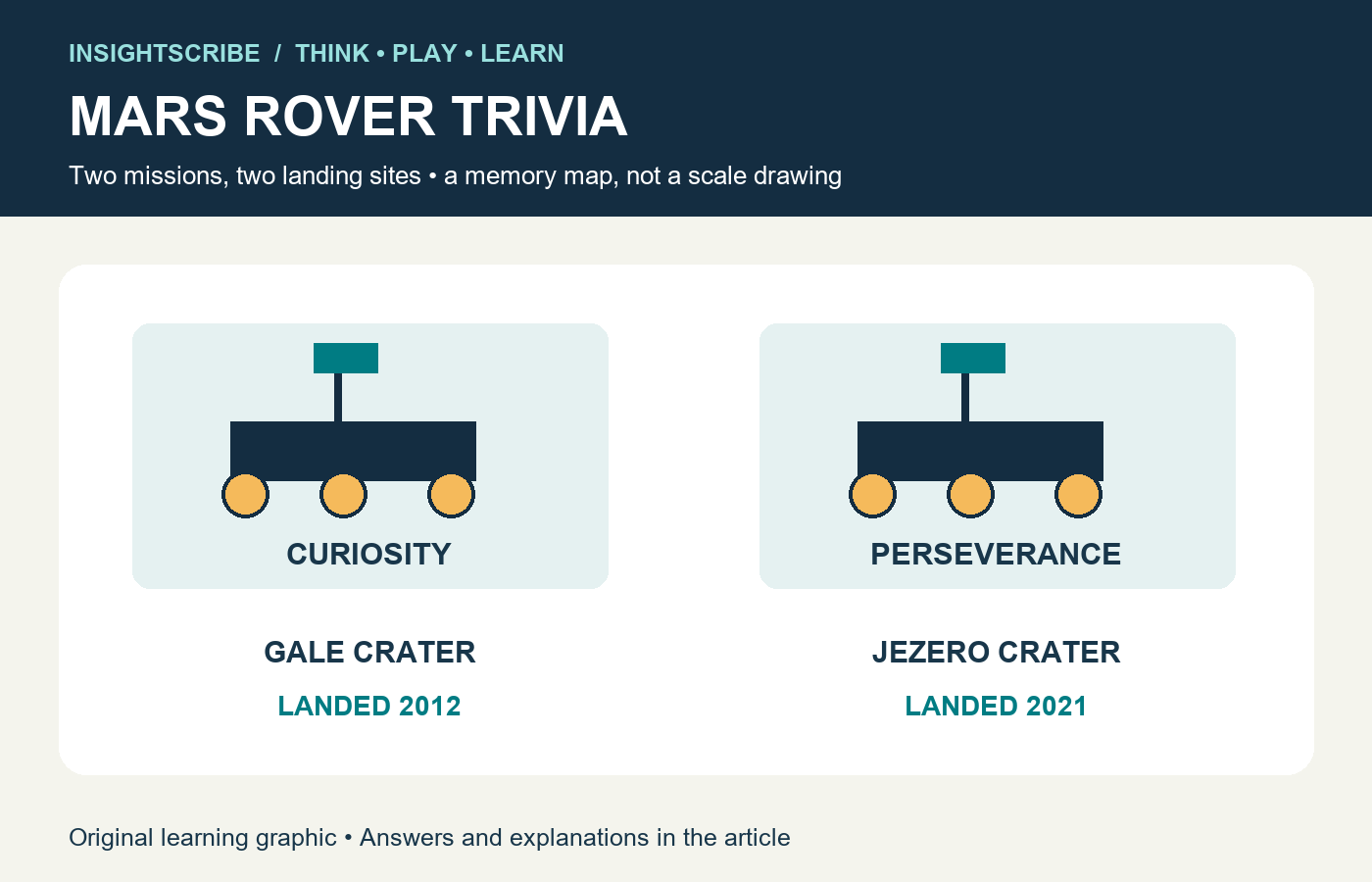
Play individually or in teams. Award one point per answer. The first five questions are an easy start; later questions ask you to distinguish a scientific clue from proof. Mission facts were checked against NASA references on October 20, 2026.
Round 1: meet the rovers
On which planet do Curiosity and Perseverance operate?
Show answer and explanation
Mars. They are robotic explorers on the Red Planet.
Which rover landed in 2012: Curiosity or Perseverance?
Show answer and explanation
Curiosity. Its landing was August 6, 2012, in UTC.
Which rover landed in February 2021?
Show answer and explanation
Perseverance. The Mars 2020 mission landed on February 18, 2021.
What crater did Perseverance land in?
Show answer and explanation
Jezero Crater. The site includes evidence of an ancient lake and river delta.
Which crater contains Curiosity’s landing site and Mount Sharp?
Show answer and explanation
Gale Crater. Curiosity studies the area’s layered rocks.
Round 2: robotic fieldwork
Which rover’s mission is also called Mars Science Laboratory?
Show answer and explanation
Curiosity. Mars Science Laboratory is the mission that delivered it.
How many wheels does Perseverance have?
Show answer and explanation
Six. The wheels form part of a suspension designed for uneven terrain.
Are the rovers carrying a human driver?
Show answer and explanation
No. They are robots operated through mission teams and onboard systems.
Does Curiosity collect drilled powdered rock for onboard analysis, or bring whole boulders into a cabin?
Show answer and explanation
Drilled powdered rock. Its drill obtains material for scientific instruments.
What kind of rock samples does Perseverance collect in tubes: drilled cores or polished gemstones?
Show answer and explanation
Drilled rock cores. It also samples other Martian material as part of its mission.
Round 3: thinking like a mission scientist
Is finding a place that could once support life the same as proving life existed there?
Show answer and explanation
No. Habitability describes suitable conditions; proof of past life requires additional evidence.
What small Mars helicopter traveled with Perseverance?
Show answer and explanation
Ingenuity. It was a technology demonstration of powered flight in Mars’s thin atmosphere.
Does “samples for possible Earth return” mean the rover has already delivered its samples to Earth?
Show answer and explanation
No. Collection and a future return mission are different stages.
Why do rover teams study rocks formed in or changed by water?
Show answer and explanation
They can preserve clues to past environments. Those clues help scientists reconstruct Mars’s history.
Which is the more careful claim: “a potential biosignature needs further study” or “every unusual rock proves life”?
Show answer and explanation
A potential biosignature needs further study. A promising observation must be tested against other explanations.
A two-question tie-breaker
Ask teams to pair Curiosity with Gale and Perseverance with Jezero, then explain why a rock sample might be more informative than a photograph alone. Accept answers about analyzing a rock’s composition or structure. Do not require an unsupported claim that either rover has proved extraterrestrial life.
Use the quiz in a classroom
Give pairs a mission name and ask them to identify one scientific goal from a NASA page. Keep “goal,” “observation” and “conclusion” in separate columns. That small distinction makes this quiz more useful than simply matching rover names to years.
More to explore
Try space trivia for planets and astronomy, or science trivia for a broader round.
Sources and review notes
Reviewed October 20, 2026. Quiz wording and explanations are written for this page; factual checks use the linked references.