Rebus Puzzle Lesson Plan: A 30-Minute Class Activity
Quick answer: This 30-minute rebus lesson teaches learners to describe a word’s position, size or arrangement, then justify a phrase answer using visible evidence. It includes a timed sequence, eight prompts and an exit ticket. It is a lesson structure, rather than another large rebus collection.
Lesson at a glance
Suggested group: confident readers in grades 3–5, adapted to the learners rather than used as a fixed age rule. Materials: board or paper, pencils and the prompts below. Objective: “I can name a visual clue and explain how it supports my answer.” No download or account is required.
Before the lesson: check vocabulary
Read the intended phrases yourself first. A rebus can be impossible for a learner who has never heard its idiom. Briefly teach unfamiliar phrases without showing which arrangement matches them. Offer oral explanations, a word bank or large-print versions; do not interpret unfamiliar English as poor reasoning.
The 30-minute teaching sequence
Minutes 0–5: notice before guessing
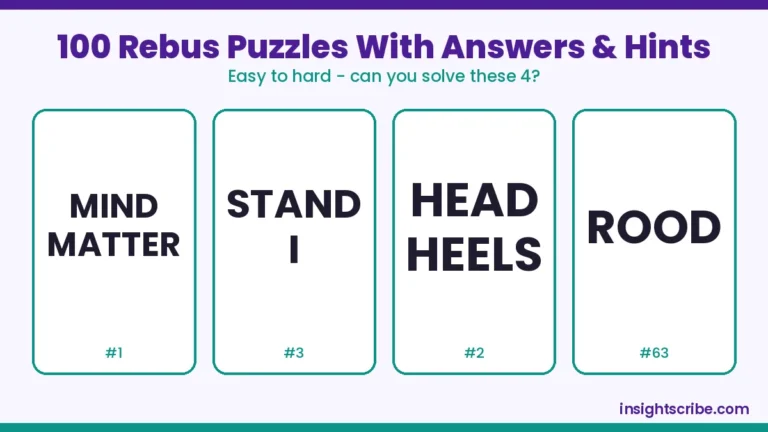
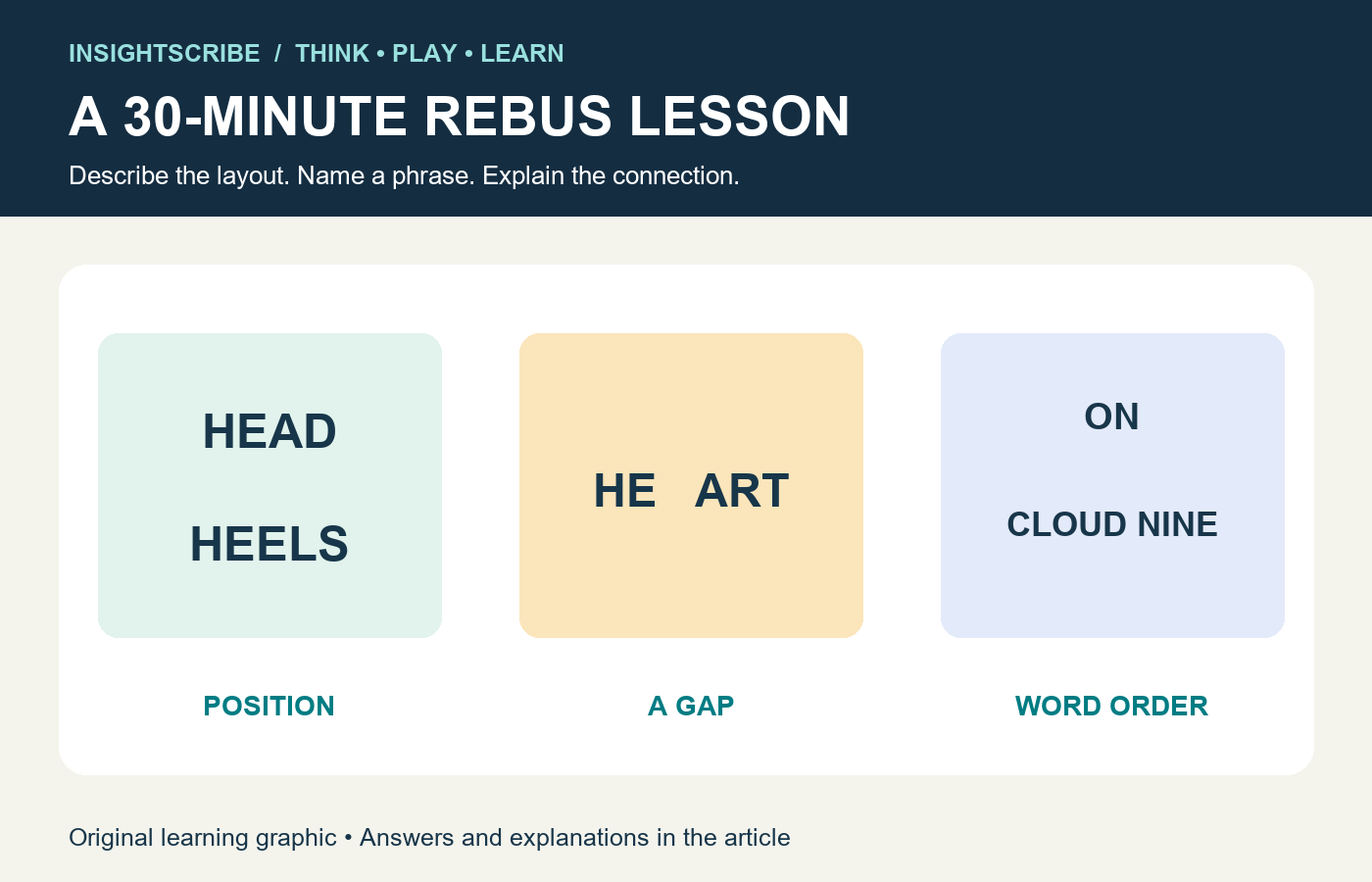
Display HEAD above HEELS. Ask, “Which word is above the other?” Record the literal description first, then connect it to “head over heels.” Explain the phrase’s figurative meaning without expecting a literal picture of a person.
Minutes 5–10: model one explanation
Use HEART with a clear gap between HE and ART. Say: “The word is broken apart, so ‘broken heart’ is a reasonable answer.” Ask whether the visual actually supports the word broken. The goal is evidence, not guessing the teacher’s password.
Minutes 10–18: pairs try four prompts
Give pairs prompts 1–4 below. One partner describes the layout; the other proposes an answer. Switch roles after two. Give the hint before revealing the answer.
Minutes 18–25: explain and design
Discuss two answers, then let each pair choose a familiar phrase and represent it with one visible relationship. A second pair tests whether the clue is enough.
Minutes 25–30: exit ticket
Ask each learner to write one layout description, one matching phrase and one sentence explaining the match. Use the rubric below to choose tomorrow’s support.
Eight practice prompts, hints and answers
The following are text descriptions so the activity also works without an image. Draw only the described words. The first three are pictured above; these familiar phrase mechanisms are examples, not claims of newly invented idioms.
1. Draw HEAD directly above HEELS. Hint: name the vertical relationship.
Show answer and explanation
Head over heels. HEAD is over HEELS.
2. Write HE, leave a visible gap, then write ART. Hint: what happened to HEART?
Show answer and explanation
Broken heart. The letters of HEART are separated into two pieces.
3. Draw ON above CLOUD NINE. Hint: read the top word, then the two words below.
Show answer and explanation
On cloud nine. ON is above CLOUD NINE; the arrangement spells out the familiar phrase. Explain the idiom as feeling very happy, not literally sitting in the sky.
4. Write STAND below I. Hint: describe STAND relative to I.
Show answer and explanation
I understand. I is above STAND, so STAND is under I; saying “I, under, stand” gives the phrase.
5. Write MAN directly above BOARD. Hint: describe the vertical relationship.
Show answer and explanation
Man overboard. MAN is over BOARD; the word over comes from position.
6. Write a very small TALK. Hint: use a size word.
Show answer and explanation
Small talk. The word TALK is small.
7. Write CYCLE twice. Hint: use the number of copies.
Show answer and explanation
Bicycle. Two cycles suggest bi-cycle, a sound-and-number rebus.
8. Write a very small BACK. Can size alone determine a unique phrase?
Show answer and explanation
No. A small BACK could suggest several readings. The writer needs a familiar target phrase or an extra hint. This is a deliberate critique prompt.
Two-point explanation rubric
1 point: identifies an observable feature, such as a gap or a word above another. 1 point: connects that feature to a plausible phrase. Accept a different answer when the learner can support it. For prompt 8, spotting ambiguity is the intended learning—not an error.
Make the next lesson easier or harder
For support, use only position and size, with a short word bank. For extension, ask learners to repair an ambiguous clue and explain why the revision is fairer. Keep design and explanation separate from handwriting or drawing skill.
Ready-made practice sets
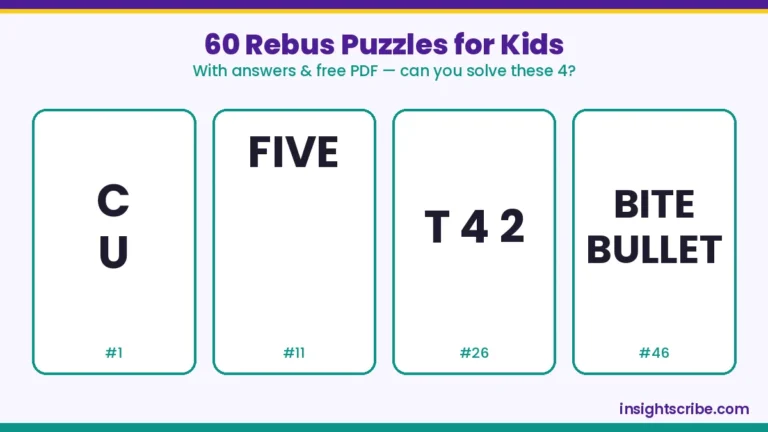
Use rebus puzzles for kids or our existing printable rebus packs for additional practice. This lesson itself does not claim a new PDF download or measured classroom outcome.