Rebus Puzzle Team Game: Rules, Scoring and 8 Rounds
Quick answer: Give teams the same rebus at the same time, collect answers after a fixed window and award points for both the phrase and its visual explanation. This eight-round game includes a score table and tie-break rule; it does not depend on fastest shouting.
Set up one fair round
Use teams of two to four, one answer sheet per team and a visible timer. Assign a reader, layout describer and recorder, rotating roles. Explain unfamiliar idioms before the game or allow a small phrase bank. Reading speed, eyesight and confidence in spoken English should not decide who gets a chance to think.
Rules to read aloud
- Every team sees the same prompt before the timer starts.
- Take 60 seconds to discuss quietly; write one phrase and one explanation.
- At 30 seconds, the host reads the same hint to every team.
- At the signal, put pencils down. Reveal answers together.
- Score the visible relationship, not exact punctuation or an accent.
- A team may challenge an answer by pointing to the actual letters or layout.
Simple scoring
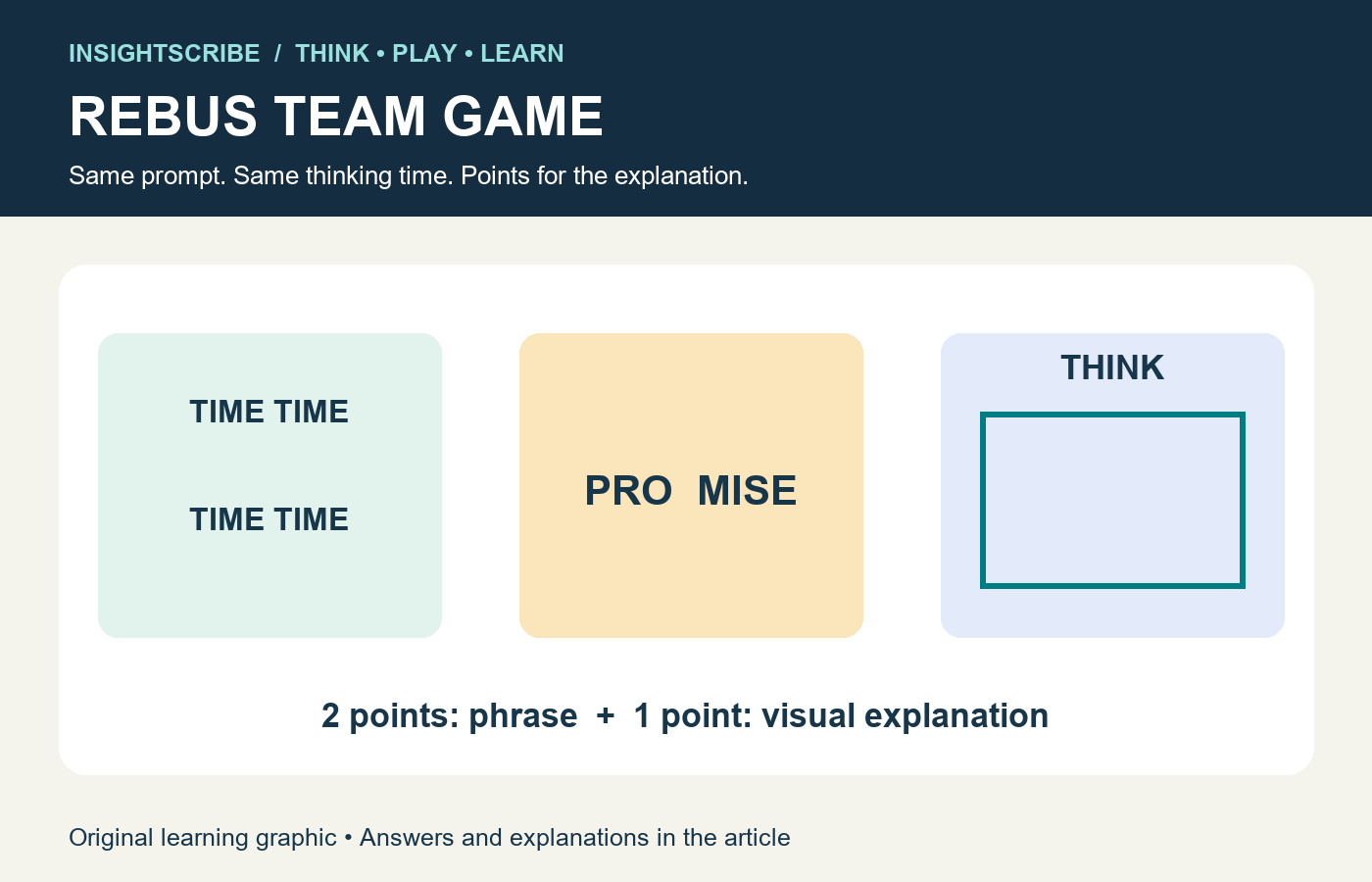
2 points: a plausible phrase that matches the prompt. 1 point: a correct explanation of the visual clue. Maximum three points per round, 24 across eight rounds. A correct phrase with no explanation earns two; a wrong phrase with a correct observation can still earn one. Hints are shared and do not cost points.
Eight rounds with host notes
Draw or display the exact arrangement described. Familiar phrase mechanisms are used for teaching the rules. Keep the answer panels closed until teams have submitted.
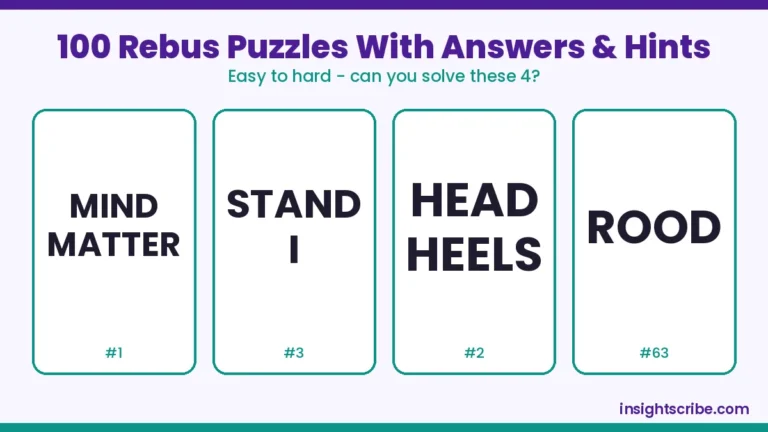
1. Write STAND directly below I. Shared hint: say the position of STAND.
Show answer and explanation
I understand. I + under + STAND produces the phrase.
2. Write TAKE twice, side by side. Shared hint: use a word meaning two.
Show answer and explanation
Double take. There are two copies of TAKE. Explain that a double take is a second look prompted by surprise.
3. Write PRO, a large gap, then MISE. Shared hint: what happened to PROMISE?
Show answer and explanation
Broken promise. The word PROMISE is broken into two parts.
4. Put THINK outside a drawn box. Shared hint: describe where THINK is.
Show answer and explanation
Think outside the box. The position carries the phrase.
5. Write SECRET inside a drawn box labeled KEEP. Shared hint: the larger container supplies a verb.
Show answer and explanation
Little secret. The word SECRET is little; accept small secret as an equivalent description.
6. Write the word TIME four times in a row. Shared hint: use the count.
Show answer and explanation
Four times. The count supplies four; the repeated word supplies times. A solver need not invent an idiom.
7. Write a very large DEAL. Shared hint: use a size word.
Show answer and explanation
Big deal. The word DEAL is big.
8. Write the letters of FALL vertically downward. Shared hint: read the direction.
Show answer and explanation
Downfall. FALL runs down the page.
Score sheet you can copy
Draw columns headed Team, Round 1 through Round 8, Total and Explanation tie-break. Record each score only after discussing challenges. A simple row might read Team A | 3 | 2 | 1 | 3 | 3 | 3 | 3 | 2 | 20. Keep names private if displaying scores publicly.
Tie-break without a shouting race
Show two versions of THINK: one inside a box, one outside. Give tied teams the same 45 seconds to explain which matches “think outside the box” and why. If both explanations are sound, share the win or use an agreed random draw. Do not invent a new speed rule after the game starts.
Fix a confusing round
If a layout supports several answers, accept supported alternatives or remove the round for everyone. Phrase knowledge still matters: accept a close reading when it fits the visible clue, and explain any unfamiliar idiom before choosing a score. Afterward, invite teams to improve one prompt.
More rebus practice
Our rebus collection offers a wider selection, and printable rebus packs provide existing paper resources. This game uses its own rules and does not claim endorsement or a new downloadable pack.