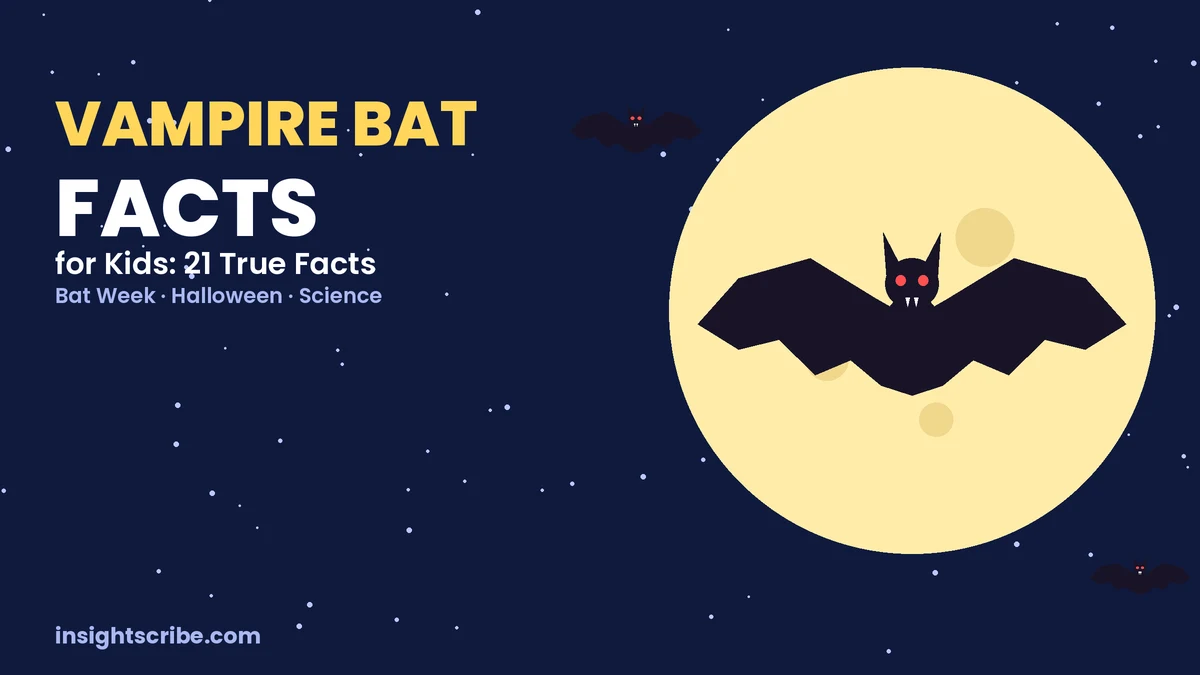
Vampire Bat Facts for Kids: 21 Fun, True Facts About Nature’s Blood-Drinking Bat
Quick answer: Vampire bats are small bats from Mexico, Central America and South America, and they are the only mammals that feed only on blood. There are just three species. A common vampire bat weighs about 2 ounces, finds warm blood with heat sensors on its nose, can run and hop on the ground, and shares food with hungry roost-mates. It drinks only about a tablespoon of blood per meal, and it doesn’t turn into a person.
The facts below come from Encyclopaedia Britannica, National Geographic Kids, the Smithsonian and published studies in the journal Nature. They’re a good fit for Halloween and Bat Week, which takes place each year in the last week of October.
Key takeaways
- There are three vampire bat species: the common, hairy-legged and white-winged vampire bats. All live in the Americas (Britannica).
- Vampire bats find blood with heat-sensing pits on their nose that pick up warmth from about 30°C (86°F) (Nature, 2011).
- They’re surprisingly social. Bats that have eaten share blood with hungry roost-mates, especially ones that have helped them before.
Vampire Bat Quick Facts
These numbers are for the common vampire bat (Desmodus rotundus), the best-known species, from National Geographic.
| Fact | Common vampire bat |
|---|---|
| Where it lives | Mexico, Central America and South America |
| Body length | About 3.5 inches (smaller than a grown-up’s hand) |
| Wingspan | About 7 inches |
| Weight | About 2 ounces |
| Lifespan in the wild | About 9 years |
| Diet | Blood, mostly from cattle, horses and other large animals |
| Group size | Usually about 100 bats, sometimes more than 1,000 |
| Conservation status | Least Concern (IUCN), with a stable population |
Vampire Bat Body and Senses Facts (1–7)
- There are only three kinds. They are the common vampire bat, the hairy-legged vampire bat and the white-winged vampire bat. Out of more than 1,400 bat species worldwide, only these three drink blood (U.S. Department of the Interior).
- They live only in the Americas. All three species live in the warm tropics and subtropics from Mexico to South America. Bats in Asia, Africa and Australia that are called “false vampire bats” don’t drink blood at all (Britannica).
- They have heat-seeking noses. Small pits around a vampire bat’s nose contain a special version of a heat-sensing protein called TRPV1. It switches on at about 30°C (86°F), which helps the bat find warm spots where blood flows close to the skin (UCSF).
- They can run. Most bats are clumsy on the ground, but vampire bats walk, hop and even run. In a 2005 study, scientists put common vampire bats on a treadmill and filmed them bounding along, using their wings like front legs (Riskin & Hermanson, Nature 2005).
- They can take off from flat ground. Strong, long thumbs let the common vampire bat leap a meter (over 3 feet) or more into the air and fly away. Britannica describes it as the only bat that can take off from the ground.
- Their teeth stay razor-sharp. Vampire bats have few teeth, but their front teeth are so sharp they make a tiny cut instead of a big bite. Their teeth lack enamel, which helps keep them sharp (UCSF).
- They recognize breathing sounds. National Geographic Kids reports that vampire bats can recognize the breathing sounds of individual animals, so they can return to the same sleeping cow night after night.
What Vampire Bats Eat (8–13)
- Blood is their only food. Vampire bats are the only mammals that feed solely on blood (Britannica).
- Each species has favorites. The common vampire bat mostly drinks from mammals like cattle and horses. The hairy-legged and white-winged vampire bats mostly feed on birds (Britannica).
- They lap, not suck. Vampire bats don’t suck blood like a straw. They lick it up, and grooves on the tongue help draw the blood in (UCSF).
- Their spit keeps blood flowing. Vampire bat saliva contains a substance scientists named draculin, which stops blood from clotting while the bat drinks (Thrombosis and Haemostasis).
- One meal is about a tablespoon. A vampire bat drinks roughly a tablespoon of blood per meal (Highlights Kids). That’s a lot for an animal this small, and a 2-ounce bat can double its weight in one feeding (Britannica).
- They can’t skip meals. According to National Geographic Kids, a vampire bat can die if it goes two nights without blood. That’s why sharing food matters so much (see below).
Vampire Bat Family and Friendship Facts (14–18)
- Babies drink milk first. Like all mammals, baby vampire bats drink their mother’s milk. They get only milk for about their first three months (National Geographic).
- They share food with friends. A bat that has eaten will bring up some blood to feed a hungry roost-mate. In a study published in Proceedings of the Royal Society B, whether a bat had helped others before predicted sharing better than being related did (Carter & Wilkinson, 2013).
- They help new moms. National Geographic Kids reports that other bats in the colony have been seen feeding a new mother for about two weeks.
- Their friendships last. Smithsonian researchers found that vampire bat friendships formed in captivity lasted after the bats were released back into the wild (Smithsonian).
- They live in big groups. Common vampire bats sleep during the day hanging upside down from cave roofs in total darkness. Their colonies usually have about 100 bats, and sometimes more than 1,000 (National Geographic).
Vampire Bat Myths vs. Facts (19–21)
- Myth: Vampire bats turn into Dracula. Fact: Vampire bats are real, ordinary (if amazing) animals. No bat can turn into a person.
- Myth: Vampire bats are related to rats. Fact: Bats aren’t rodents. Studies of bat genes show they’re more closely related to horses and dogs than to rats (UCSF).
- Myth: Vampire bats are endangered. Fact: The common vampire bat is listed as Least Concern, with a stable population (National Geographic). Many other bats are in trouble, though. In North America, a disease called white-nose syndrome has killed millions of bats (U.S. Department of the Interior).
Safety note: Never touch a wild bat. Vampire bats and other bats can carry rabies, so tell an adult if you find a bat on the ground.
Bat Week Activities for Kids
Bat Week runs each year in the last week of October, right before Halloween. Here are four ways to celebrate:
- Measure a bat. Cut a paper strip 7 inches long to see a common vampire bat’s wingspan, then compare it with your arm span.
- Do the tablespoon test. Fill a tablespoon with red-tinted water to see how much a vampire bat drinks in one meal.
- Play “share the snack.” Act out how vampire bats share food, and talk about why helping friends matters.
- Try bat riddles and trivia. Solve our bat riddles for International Bat Night, then quiz the family with animal trivia for kids.
Hungry for more? Explore our animal fun facts, more fun facts for kids, and a spooky round of Halloween trivia questions.
Vampire Bat FAQ
Do vampire bats really drink blood?
Yes. Vampire bats are the only mammals that feed only on blood. They make a tiny cut with their sharp front teeth and lap up about a tablespoon of blood. Their saliva keeps the blood from clotting.
Where do vampire bats live?
All three vampire bat species live in the Americas, from Mexico through Central America to South America. They spend the day roosting in dark caves.
How big is a vampire bat?
A common vampire bat’s body is about 3.5 inches long, and it has a wingspan of about 7 inches and weighs about 2 ounces.
Are vampire bats dangerous to people?
Vampire bats usually feed on sleeping cattle and horses, though National Geographic notes they have been known to feed on people. They don’t drink enough blood to harm their host, but their bites can become infected and they can spread rabies. Never touch a wild bat.
How many types of vampire bats are there?
There are three: the common vampire bat (Desmodus rotundus), the hairy-legged vampire bat (Diphylla ecaudata) and the white-winged vampire bat (Diaemus youngi).
Sources: Britannica: Vampire bat; National Geographic: Common vampire bat; National Geographic Kids: Vampire bat; Highlights Kids; Riskin & Hermanson (2005), Nature; Gracheva et al. (2011), Nature; UCSF; Carter & Wilkinson (2013); Smithsonian; U.S. Department of the Interior; Bat Week.
Last updated: October 2026.