General Knowledge Trivia Questions & Answers
General knowledge trivia is the classic mixed-topic quiz: a good round moves between science, geography, history, books and culture so different players get a chance to shine. These questions use stable facts and short explanations rather than current-affairs answers that can change quickly.
For focused rounds, try our science trivia, geography trivia, history trivia or browse the Trivia hub.
How to Play
- Read the question fully before anyone answers.
- Award 1 point for each correct answer.
- Rotate the reader between rounds.
- Use the final section as a tie-breaker if needed.
Science & Nature
Q1. What is the largest planet in our solar system?
Answer: Jupiter. Why: Jupiter is the largest planet by both mass and diameter.
Q2. What gas makes up most of Earth’s atmosphere?
Answer: Nitrogen. Why: Nitrogen makes up about 78 percent of dry air.
Q3. What is the chemical symbol for gold?
Answer: Au. Why: The symbol comes from the Latin word aurum.
Q4. What is the hardest naturally occurring mineral on the Mohs scale?
Answer: Diamond. Why: Diamond is rated 10 on the Mohs scale.
Q5. What is the closest star to Earth?
Answer: The Sun. Why: The Sun is the star at the center of our solar system.
Q6. How many bones are in a typical adult human skeleton?
Answer: 206. Why: Most adults have 206 bones, though small natural variations can occur.
Q7. Which mammals are capable of true sustained flight?
Answer: Bats. Why: Other mammals such as flying squirrels glide rather than fly under power.
Q8. What process lets green plants use light energy to make sugars?
Answer: Photosynthesis. Why: Plants use light, carbon dioxide and water to produce sugars.
Geography & World
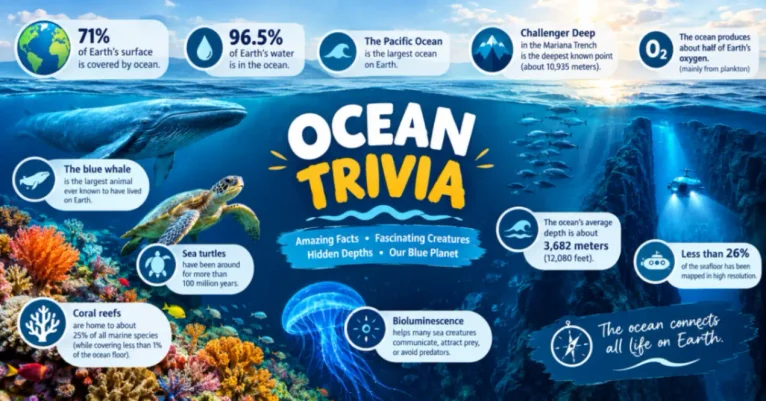
Q9. What is the largest ocean on Earth?
Answer: The Pacific Ocean. Why: The Pacific is Earth’s largest ocean basin.
Q10. What is the smallest sovereign state in the world?
Answer: Vatican City. Why: It is an independent state surrounded by Rome, Italy.
Q11. What is the capital of Australia?
Answer: Canberra. Why: Canberra, not Sydney or Melbourne, is Australia’s capital.
Q12. What is the largest hot desert in the world?
Answer: The Sahara. Why: The Sahara stretches across much of North Africa.
Q13. Which river flows through Vienna, Bratislava, Budapest and Belgrade?
Answer: The Danube. Why: The Danube crosses or borders several European countries.
Q14. What is the world’s largest island that is not considered a continent?
Answer: Greenland. Why: Greenland is the world’s largest island by area.
Q15. What imaginary line is at 0 degrees latitude?
Answer: The Equator. Why: It divides Earth into the Northern and Southern Hemispheres.
Q16. Which country contains the ancient city of Petra?
Answer: Jordan. Why: Petra was a major city of the Nabataean kingdom.
History
Q17. Who was the first president of the United States?
Answer: George Washington. Why: Washington took office in 1789.
Q18. Which ancient civilization built the pyramids at Giza?
Answer: The ancient Egyptians. Why: The Giza pyramids were royal tombs of Egypt’s Old Kingdom.
Q19. Which city was buried by Mount Vesuvius in 79 CE?
Answer: Pompeii. Why: Volcanic material preserved much of the Roman city.
Q20. Which document was adopted by the Continental Congress on July 4, 1776?
Answer: The U.S. Declaration of Independence. Why: It announced the colonies’ separation from Great Britain.
Q21. Which empire built Machu Picchu?
Answer: The Inca Empire. Why: Machu Picchu is in present-day Peru.
Q22. What event in 1789 is often used to symbolize the start of the French Revolution?
Answer: The storming of the Bastille. Why: The fortress-prison was seized on July 14, 1789.
Q23. In what year did World War II end?
Answer: 1945. Why: The war ended in Europe in May and in the Pacific in September.
Q24. Who was the first person to walk on the Moon?
Answer: Neil Armstrong. Why: Armstrong stepped onto the lunar surface during Apollo 11 in 1969.
Arts, Books & Culture
Q25. Who painted the Mona Lisa?
Answer: Leonardo da Vinci. Why: The painting is displayed at the Louvre Museum.
Q26. Who wrote Pride and Prejudice?
Answer: Jane Austen. Why: The novel was first published in 1813.
Q27. Which composer wrote The Four Seasons?
Answer: Antonio Vivaldi. Why: It is a set of four violin concertos.
Q28. Who wrote Hamlet?
Answer: William Shakespeare. Why: Hamlet is one of Shakespeare’s tragedies.
Q29. Which artist painted The Persistence of Memory?
Answer: Salvador Dalí. Why: The 1931 painting is closely associated with Surrealism.
Q30. What is a word that reads the same forward and backward called?
Answer: A palindrome. Why: Examples include level and civic.
Q31. What number does the Roman numeral X represent?
Answer: 10. Why: X is the Roman numeral for ten.
Q32. What instrument usually has 88 keys?
Answer: The piano. Why: A standard full-size piano has 88 keys.
Challenge Round
Q33. Which element has the chemical symbol W?
Answer: Tungsten. Why: The symbol comes from the older name wolfram.
Q34. What is the capital of Burkina Faso?
Answer: Ouagadougou. Why: Ouagadougou is the country’s capital and largest city.
Q35. What is the study of fungi called?
Answer: Mycology. Why: Mycology is a branch of biology.
Q36. Which sea is bounded mainly by ocean currents rather than land?
Answer: The Sargasso Sea. Why: It lies in the North Atlantic and is defined by surrounding currents.
Q37. Who formulated the three laws of planetary motion?
Answer: Johannes Kepler. Why: Kepler described planetary motion using elliptical orbits.
Q38. Which novel begins with the line “Call me Ishmael”?
Answer: Moby-Dick. Why: Herman Melville’s novel was published in 1851.
Q39. What is the deepest known point in Earth’s oceans called?
Answer: Challenger Deep. Why: It is located in the Mariana Trench.
Q40. Which empire was ruled by Mansa Musa in the 14th century?
Answer: The Mali Empire. Why: Mansa Musa is remembered for the wealth and influence of medieval Mali.
Score Guide
- 0–15: Good start — you found plenty to learn.
- 16–28: Strong general knowledge.
- 29–35: Excellent quiz form.
- 36–40: Outstanding — very little got past you.
Reliable Sources
Key factual claims were checked against established government, museum, scientific or educational references:
- NASA Science — Solar System Facts
- U.S. Geological Survey — Oceans and Seas
- U.S. National Archives — Declaration of Independence
- Smithsonian National Zoo — Animals
FAQ
What does general knowledge trivia include? It mixes broad subjects such as science, history, geography, literature and culture rather than focusing on one specialist topic.
How should I run a general knowledge round? Mix categories, keep one clear answer per question and save the hardest items for the final section.