160 Ocean Trivia Questions & Answers (Easy to Hard)
Ready to test how much you know about the sea? This collection includes 160 ocean trivia questions and answers, from easy geography and marine animals to deep-sea science, exploration, true-or-false questions, and hard ocean facts.
You can use these questions for family game night, school, classrooms, parties, pub quizzes, or simply to learn something new about the world’s oceans.
Ocean Trivia: Quick Facts
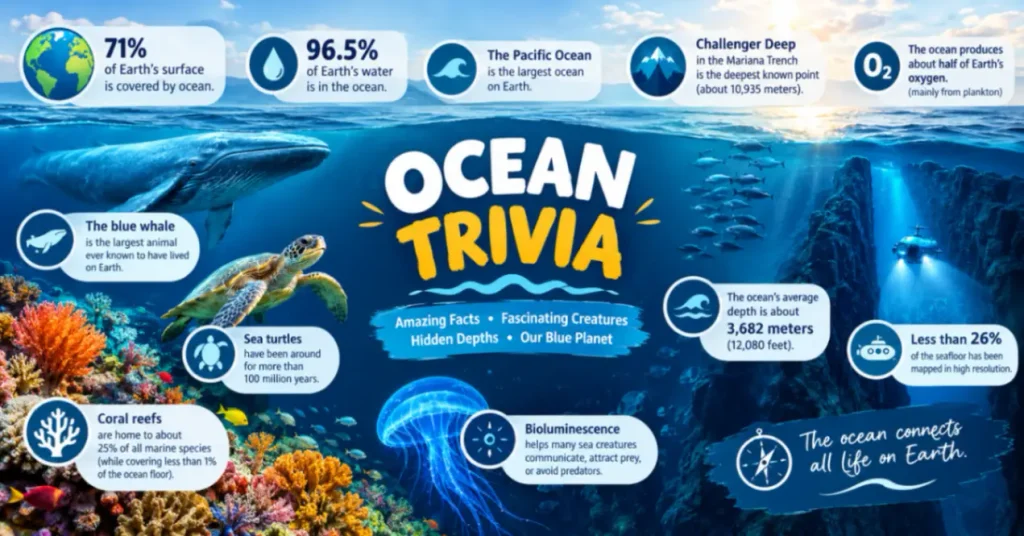
- About 71% of Earth’s surface is water-covered, according to the U.S. Geological Survey.
- The oceans hold about 96.5% of Earth’s water.
- The Pacific Ocean is the largest named ocean.
- Challenger Deep in the Mariana Trench is the deepest known point in the ocean.
- The average ocean depth is about 3,682 meters (12,080 feet).
- Roughly half of Earth’s oxygen production comes from the ocean, much of it from photosynthetic plankton, according to NOAA Ocean Service.
- As of April 2026, NOAA Ocean Exploration reported that about 28.7% of the global seafloor had been mapped with modern high-resolution technology.
Want a specific type of quiz? Jump to easy questions first, then move into geography, animals, the deep sea, science, exploration, hard questions, and kid-friendly true-or-false trivia.
Easy Ocean Trivia
Start here if you want quick warm-up questions. For more beginner-friendly questions across different topics, see our easy trivia questions.
- Which is the largest ocean on Earth?
Answer: The Pacific Ocean.
Quick fact: The Pacific is so large that it covers more area than all of Earth’s land combined. - About how much of Earth’s surface is covered by water?
Answer: About 71%. - Which is the smallest of the five named oceans?
Answer: The Arctic Ocean. - Which ocean lies between the Americas and Europe/Africa?
Answer: The Atlantic Ocean. - Which ocean lies mainly between Africa, Asia, and Australia?
Answer: The Indian Ocean. - Which ocean surrounds Antarctica?
Answer: The Southern Ocean. - What is the deepest known point in the ocean?
Answer: Challenger Deep.
Quick fact: It lies inside the Mariana Trench in the western Pacific. - Which trench contains Challenger Deep?
Answer: The Mariana Trench. - Which ocean contains the Mariana Trench?
Answer: The Pacific Ocean. - What is seawater’s most common dissolved salt?
Answer: Sodium chloride. - What do we call a large body of salt water smaller than an ocean?
Answer: A sea. - What do we call the regular rise and fall of sea level?
Answer: Tides. - What mainly causes ocean tides?
Answer: The gravitational pull of the Moon and, to a lesser extent, the Sun.
Quick fact: The Moon has the stronger tidal influence because it is much closer to Earth. - What is a wave?
Answer: A transfer of energy through water. - What is a current?
Answer: A large-scale movement of seawater. - What color does deep, clear ocean water often appear?
Answer: Blue. - What is the line where land meets the sea called?
Answer: The coastline or shore. - What is an island?
Answer: Land completely surrounded by water. - What is a peninsula?
Answer: Land almost surrounded by water but connected to the mainland. - What is a bay?
Answer: A body of water partly enclosed by land.
Ocean Geography Trivia
These questions focus on oceans, trenches, islands, ridges, and seafloor geography. You can also test broader world knowledge with our geography trivia questions.
- Which ocean is larger than all of Earth’s land area combined?
Answer: The Pacific Ocean. - What is the world’s longest mountain system?
Answer: The mid-ocean ridge system.
Quick fact: Most of this enormous mountain chain is hidden beneath the ocean surface. - What is an ocean trench?
Answer: A long, narrow, very deep depression in the seafloor. - What is a seamount?
Answer: An underwater mountain that rises from the seafloor but does not reach the surface. - What is an abyssal plain?
Answer: A broad, very flat area of the deep-ocean floor. - What is the continental shelf?
Answer: The shallow submerged edge of a continent. - What is the continental slope?
Answer: The steep descent from the continental shelf toward the deep ocean. - What is an atoll?
Answer: A ring-shaped coral reef or island surrounding a lagoon. - What is an archipelago?
Answer: A group or chain of islands. - What is a strait?
Answer: A narrow waterway connecting two larger bodies of water. - What is an isthmus?
Answer: A narrow strip of land connecting two larger land areas. - Which ocean separates Africa from Australia?
Answer: The Indian Ocean. - Which ocean lies west of North and South America?
Answer: The Pacific Ocean. - Which ocean lies north of Europe, Asia, and North America?
Answer: The Arctic Ocean. - What is the name for one interconnected body formed by all Earth’s oceans?
Answer: The global ocean. - What is bathymetry?
Answer: The measurement and mapping of underwater depth and seafloor shape.
Quick fact: Modern bathymetric maps often use multibeam sonar from research vessels. - What is the approximate average depth of the ocean?
Answer: About 3,682 meters (12,080 feet). - What do we call a deep underwater canyon cut into the continental margin?
Answer: A submarine canyon. - What forms when tectonic plates move apart beneath the ocean?
Answer: Mid-ocean ridges and new oceanic crust. - What is an ocean basin?
Answer: A large depression in Earth’s surface occupied by ocean water.
Marine Animal Trivia
This section moves from ocean geography to the animals that live there. For more wildlife questions, try our animal trivia questions.
- What is the largest animal known to have lived?
Answer: The blue whale.
Quick fact: Blue whales are larger than any known dinosaur by body mass. - What is the largest fish?
Answer: The whale shark. - How many hearts does an octopus have?
Answer: Three.
Quick fact: Two hearts move blood through the gills while one circulates it through the body. - How many arms does an octopus have?
Answer: Eight. - Are dolphins fish or mammals?
Answer: Mammals. - Are whales fish or mammals?
Answer: Mammals. - What do baleen whales use instead of teeth to filter food?
Answer: Baleen plates. - Which marine mammal is famous for using echolocation?
Answer: The dolphin. - What is the largest species of sea turtle?
Answer: The leatherback sea turtle. - What do sea turtles use to breathe?
Answer: Lungs. - Can sharks replace lost teeth?
Answer: Yes. Many sharks continually replace teeth throughout life.
Quick fact: Replacement teeth develop in rows behind the active teeth. - What type of skeleton do sharks have?
Answer: A cartilaginous skeleton. - What are jellyfish mostly made of?
Answer: Water. - What is a group of fish swimming together called?
Answer: A school. - What is a baby seal commonly called?
Answer: A pup. - What marine animal has a hard shell and five pairs of legs, with the first pair often forming claws?
Answer: A crab. - What do sea stars use tube feet for?
Answer: Movement, feeding, and gripping surfaces. - What do corals build over time?
Answer: Coral reefs. - What is the largest species of penguin?
Answer: The emperor penguin. - What is the name for animals such as squid, octopuses, and cuttlefish?
Answer: Cephalopods.
Deep Sea Trivia
- What is the hadal zone?
Answer: The deepest ocean zone, mainly associated with trenches. - Does sunlight reach the deepest parts of the ocean?
Answer: No. - Why is pressure so high in the deep ocean?
Answer: Because of the weight of the water above. - What is bioluminescence?
Answer: Light produced by a chemical reaction inside a living organism.
Quick fact: Deep-sea animals may use light to attract prey, communicate, hide, or confuse predators. - What is marine snow?
Answer: Particles of organic and inorganic material that sink from upper waters into the deep ocean. - What is a hydrothermal vent?
Answer: A seafloor opening that releases heated, mineral-rich water.
Quick fact: Vent ecosystems can thrive without sunlight because microbes use chemical energy. - What is chemosynthesis?
Answer: The process of making organic matter using chemical energy instead of sunlight. - What giant deep-sea squid is famous for having enormous eyes?
Answer: The colossal squid. - What fish is known for a glowing lure used to attract prey?
Answer: The anglerfish.
Quick fact: In many deep-sea anglerfish, the lure contains light-producing bacteria. - What is the twilight zone of the ocean also called?
Answer: The mesopelagic zone. - What is the sunlit upper layer of the ocean commonly called?
Answer: The epipelagic zone. - What is the midnight zone commonly called?
Answer: The bathypelagic zone. - What is the abyssal zone?
Answer: A very deep ocean zone generally below about 4,000 meters. - Why are many deep-sea animals soft-bodied?
Answer: Soft bodies can be well suited to high-pressure environments where gas-filled spaces are disadvantageous. - Can life exist around hydrothermal vents without sunlight?
Answer: Yes. - What do many vent food webs depend on?
Answer: Chemosynthetic microorganisms. - What is a cold seep?
Answer: An area where fluids rich in chemicals such as methane or hydrogen sulfide escape from the seafloor. - What is a brine pool on the seafloor?
Answer: A very salty body of water that can be denser than surrounding seawater. - Why are deep-sea expeditions difficult?
Answer: Extreme pressure, darkness, cold, distance, and cost. - What kind of vehicle can explore depths too dangerous for divers?
Answer: A submersible, remotely operated vehicle (ROV), or autonomous underwater vehicle (AUV).
Ocean Science Trivia
- What is salinity?
Answer: The amount of dissolved salts in water. - What is the average salinity of open-ocean seawater?
Answer: About 35 parts per thousand, though it varies.
Quick fact: Salinity changes with evaporation, rainfall, river input, and sea-ice formation or melting. - What is ocean acidification?
Answer: A long-term decrease in ocean pH driven mainly by absorption of atmospheric carbon dioxide. - Does ocean acidification mean seawater becomes a strong acid?
Answer: No. Seawater remains generally alkaline, but its pH decreases. - What are phytoplankton?
Answer: Tiny photosynthetic organisms that drift in sunlit waters. - Roughly how much of Earth’s oxygen production comes from the ocean?
Answer: About half.
Quick fact: Much of this production comes from microscopic photosynthetic plankton. - What is thermohaline circulation?
Answer: Large-scale ocean circulation influenced by differences in temperature and salinity. - What is upwelling?
Answer: The rise of deeper, usually colder and nutrient-rich water toward the surface.
Quick fact: Upwelling regions can support exceptionally productive fisheries. - Why is upwelling important for marine life?
Answer: It brings nutrients into sunlit waters, supporting plankton and food webs. - What is El Niño?
Answer: A recurring warming of the central and eastern tropical Pacific that affects weather and ocean conditions. - What is La Niña?
Answer: A recurring cooling of the central and eastern tropical Pacific that affects weather and ocean conditions. - Why does seawater freeze at a lower temperature than fresh water?
Answer: Dissolved salts lower its freezing point. - What is sea ice?
Answer: Frozen seawater floating on the ocean.
Quick fact: Sea ice forms from ocean water, unlike icebergs, which originate from land ice. - What is an iceberg?
Answer: A floating mass of freshwater ice that has broken from a glacier or ice shelf. - What is a thermocline?
Answer: A layer where water temperature changes rapidly with depth. - What is density in seawater affected by?
Answer: Mainly temperature and salinity. - What causes most surface ocean currents?
Answer: Wind, modified by Earth’s rotation and basin shapes. - What is the Coriolis effect?
Answer: The apparent deflection of moving air and water caused by Earth’s rotation. - What is a gyre?
Answer: A large rotating system of ocean currents. - What is the water cycle process that moves water from ocean to atmosphere?
Answer: Evaporation.
Ocean Exploration & History Trivia
- What ship gave Challenger Deep its name?
Answer: HMS Challenger. - When did the Challenger expedition take place?
Answer: 1872–1876. - Who first reached Challenger Deep in a crewed vessel in 1960?
Answer: Jacques Piccard and Don Walsh.
Quick fact: They made the descent aboard the bathyscaphe Trieste. - What was the name of their vessel?
Answer: Trieste. - Who made a solo dive to Challenger Deep in 2012?
Answer: James Cameron.
Quick fact: His one-person submersible was called DEEPSEA CHALLENGER. - What was Cameron’s submersible called?
Answer: DEEPSEA CHALLENGER. - What organization operates the research submersible Alvin?
Answer: Woods Hole Oceanographic Institution, with support from the U.S. Navy and NSF. - What was Alvin famously used to explore in 1986?
Answer: The wreck of RMS Titanic. - What is sonar?
Answer: A method that uses sound waves to detect or map objects underwater.
Quick fact: Sonar is especially useful underwater because sound travels much farther through water than light. - Why is sonar useful in the ocean?
Answer: Sound travels well underwater and can measure depth and locate objects. - What is an ROV?
Answer: A remotely operated vehicle controlled from a ship or platform. - What is an AUV?
Answer: An autonomous underwater vehicle that can operate without a direct tether. - What does a CTD instrument measure?
Answer: Conductivity, temperature, and depth. - What is a research vessel?
Answer: A ship equipped for scientific study. - What is deep-sea sampling?
Answer: Collecting water, sediment, rocks, or organisms from depth for study. - What is an ocean observatory?
Answer: A system of instruments that continuously or repeatedly measures ocean conditions. - What is satellite altimetry used for in ocean science?
Answer: Measuring sea-surface height and helping infer currents and broad seafloor features. - Can satellites directly map every fine detail of the seafloor?
Answer: No. Ship-based sonar provides much higher-resolution bathymetry. - As of April 2026, about what share of the global seafloor had been mapped with modern high-resolution technology?
Answer: About 28.7%, according to NOAA Ocean Exploration.
Quick fact: Satellite maps cover the whole seafloor broadly, but ship-based multibeam sonar reveals much finer detail. - Why is high-resolution seafloor mapping still incomplete?
Answer: The ocean is vast, deep, expensive, and time-consuming to survey with ships.
Hard Ocean Trivia
These questions use more advanced ocean-science terms. If you want another difficult quiz after this one, visit our hard trivia questions.
- What is the name of the boundary between two water masses with a sharp salinity change?
Answer: A halocline. - What is the name of the boundary where density changes rapidly with depth?
Answer: A pycnocline. - What is Ekman transport?
Answer: The net movement of surface water at an angle to the wind because of friction and Earth’s rotation. - What is a black smoker?
Answer: A hydrothermal vent that emits dark, mineral-rich fluid.
Quick fact: The dark appearance comes from mineral particles that precipitate as the hot fluid meets cold seawater. - What is a white smoker?
Answer: A hydrothermal vent that emits lighter-colored mineral-rich fluid. - What is benthic life?
Answer: Organisms living on or in the seafloor. - What is pelagic life?
Answer: Organisms living in the open water column away from the bottom. - What is nekton?
Answer: Aquatic animals that can swim actively against currents. - What is plankton?
Answer: Organisms that drift with currents and cannot effectively swim against them over large scales. - What is the biological pump?
Answer: Processes that move carbon from surface waters into the deep ocean, often through sinking organic matter.
Quick fact: Marine snow is one way organic carbon travels from surface waters toward the deep sea. - What is an oxygen minimum zone?
Answer: A layer of water where dissolved oxygen is especially low. - What is a dead zone?
Answer: An area with oxygen levels too low to support many forms of marine life. - What nutrient often limits phytoplankton growth in large ocean regions?
Answer: Nitrogen is common, while iron can be limiting in some major regions. - What is a tidal bore?
Answer: A wave that travels upstream in a river or estuary when an incoming tide pushes against the river flow. - What is an internal wave?
Answer: A wave that travels within the ocean along layers of different density. - What is a rogue wave?
Answer: An unusually large and unexpected ocean wave. - What is a tsunami?
Answer: A series of long waves usually caused by sudden displacement of a large volume of water.
Quick fact: A tsunami can cross an entire ocean basin before reaching shore. - What commonly causes tsunamis?
Answer: Undersea earthquakes, though landslides and volcanic activity can also cause them. - What is ocean stratification?
Answer: The layering of seawater by differences in density. - What is thermohaline mixing important for?
Answer: Redistributing heat, oxygen, carbon, and nutrients through the ocean.
Kids, True-or-False & Fun Ocean Trivia
These are easier to use in classrooms and family game nights. You may also like our family trivia questions.
- True or false: A whale shark is a whale.
Answer: False. It is a fish. - True or false: An octopus has three hearts.
Answer: True. - True or false: Dolphins breathe through gills.
Answer: False. They breathe air with lungs. - True or false: Coral is a plant.
Answer: False. Corals are animals.
Quick fact: Reef-building corals live in partnership with microscopic algae that provide much of their energy. - True or false: All sharks are dangerous to humans.
Answer: False. - True or false: The Pacific is the largest ocean.
Answer: True. - True or false: Sea turtles can breathe underwater like fish.
Answer: False. - True or false: Some ocean animals make their own light.
Answer: True. - True or false: The deepest ocean has sunlight.
Answer: False. - True or false: The five named oceans are physically connected.
Answer: True. - Which animal is known for changing color and texture for camouflage?
Answer: The octopus, among other cephalopods. - Which sea creature has a star-shaped body and tube feet?
Answer: A sea star. - Which marine mammal is famous for tusks and lives in Arctic waters?
Answer: The walrus. - Which fish can inflate its body when threatened?
Answer: The pufferfish. - Which animal carries young in a pouch, with the male becoming pregnant?
Answer: The seahorse.
Quick fact: Female seahorses transfer eggs into the male’s brood pouch, where they develop. - What tiny organisms form the base of many ocean food webs?
Answer: Plankton. - What do clownfish famously live among?
Answer: Sea anemones. - What do hermit crabs often use for protection?
Answer: Empty shells. - What is a group of dolphins commonly called?
Answer: A pod. - What is one simple reason the ocean looks blue?
Answer: Water absorbs red wavelengths more strongly while blue light penetrates and scatters more effectively.
Ocean Trivia Comparison Table
| Ocean fact | Quick answer |
|---|---|
| Largest named ocean | Pacific Ocean |
| Smallest named ocean | Arctic Ocean |
| Deepest known point | Challenger Deep |
| Trench containing Challenger Deep | Mariana Trench |
| Approximate average depth | 3,682 m (12,080 ft) |
| Earth’s surface covered by water | About 71% |
| Earth’s water held by oceans | About 96.5% |
| Largest known animal | Blue whale |
| Largest fish | Whale shark |
| Octopus hearts | Three |
| High-resolution global seafloor mapped | About 28.7% as of April 2026 |
More Trivia You May Like
For another seasonal quiz, try our summer trivia questions.
FAQs About Ocean Trivia
What are some good ocean trivia questions?
Good ocean trivia mixes easy facts with surprising questions about marine animals, geography, trenches, currents, tides, ocean zones, exploration, and deep-sea life. A varied quiz keeps both kids and adults interested.
How many oceans are there?
Five named oceans are commonly recognized: the Pacific, Atlantic, Indian, Arctic, and Southern. Physically, they are connected parts of one global ocean.
What is the deepest part of the ocean?
The deepest known point is Challenger Deep in the Mariana Trench in the western Pacific Ocean. Measurements can vary slightly depending on method and location.
How much of Earth is covered by ocean?
About 71% of Earth’s surface is water-covered, and the oceans contain about 96.5% of all Earth’s water.
How much oxygen comes from the ocean?
Scientists estimate that roughly half of Earth’s oxygen production comes from the ocean, with much of it produced by photosynthetic plankton.
How much of the seafloor has been mapped?
NOAA Ocean Exploration reported that 28.7% of the global seafloor had been mapped with modern high-resolution technology as of April 2026. Satellite data provide broad global coverage, but ship-based sonar reveals much finer detail.
Reliable Sources
Key science facts in this article were checked against authoritative sources:
- U.S. Geological Survey — How Much Water Is There on Earth?
- NOAA Ocean Service — How Much Oxygen Comes From the Ocean?
- NOAA Ocean Exploration — How Much of the Ocean Has Been Explored?
- Woods Hole Oceanographic Institution — Ocean Zones
Conclusion
Ocean trivia is more than memorizing the biggest ocean or deepest trench. These 160 questions connect geography, animals, geology, chemistry, climate, exploration, and the strange life found far below the surface.
Start with the easy questions, challenge yourself with the hard section, and share the quiz with friends, family, students, or anyone who loves the ocean.
Explore more topics in our Trivia hub for more questions, answers and quiz collections.