Beginner Rubik’s Cube Algorithms Cheat Sheet: The 7 Sequences You Need
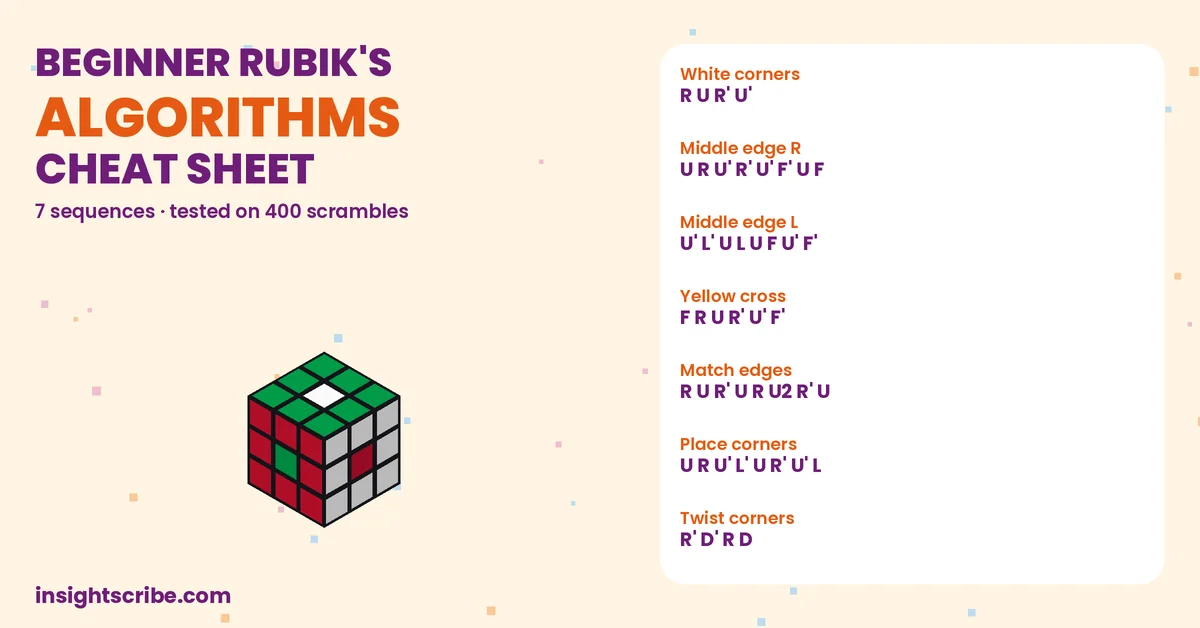
Quick answer: A beginner needs just seven short move sequences to solve a Rubik’s Cube layer by layer: R U R' U' for the white corners, two sequences for the middle edges, F R U R' U' F' for the yellow cross, and three for the last-layer corners and edges. Hold the cube with white on the bottom and yellow on top, work through the seven steps in order, and use the cheat sheet table below as your guide.
This cheat sheet uses the classic seven-step beginner method (white cross, white corners, middle layer, yellow cross, yellow edges, yellow corners, corner twists). We did not just copy sequences from other guides. We wrote a computer model of a 3×3 cube that follows this exact page, step by step, and ran it on 400 random scrambles of 25 to 35 moves. It solved all 400, and every number you will see below (how many times to repeat, which cases need which sequence) comes from those runs.
Key takeaways
- Seven sequences, four to eight moves each, solve the whole cube. Step 1 (the white cross) needs no memorized sequence.
- Hold white on the bottom and yellow on top, and never turn the whole cube in the middle of a sequence.
- The corner trick
R U R' U'seats a white corner after 1, 3 or 5 repeats: 1 if the white sticker faces right, 3 if it faces up, 5 if it faces the front. - The yellow cross always arrives in at most three uses of
F R U R' U' F': dot, then L-shape, then line, then cross. - The corner twist
R' D' R Dalways needs 2 or 4 repeats per corner. The cube looks scrambled until the last corner is done, and that is normal.
Contents
- Before you start: notation and how to hold the cube
- The cheat sheet table
- Step 1: White cross
- Step 2: White corners
- Step 3: Middle layer edges
- Step 4: Yellow cross
- Step 5: Match the yellow edges
- Step 6: Place the yellow corners
- Step 7: Twist the yellow corners
- Tips for staying on track
- FAQ
Before You Start: Notation and How to Hold the Cube
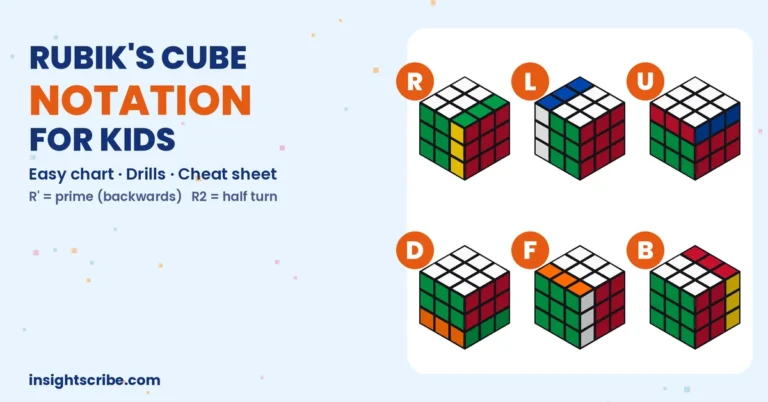
The letters in the sequences name the six faces: R (right), L (left), U (up), D (down), F (front) and B (back). A plain letter is a quarter turn clockwise as you look at that face, a prime (‘) is counterclockwise and a 2 is a half turn. If any of that is new, read our Rubik’s Cube notation for kids guide first; it takes five minutes.
Hold the cube with white on the bottom and yellow on top for the whole solve. Each sequence is written for a cube held that way. Pick any side as the front. When the instructions say “hold the corner at the front-right,” they mean the top-layer corner where the front and right faces meet. Between sequences you may turn the whole cube to bring a piece to the front, but never turn the whole cube in the middle of a sequence.
The Cheat Sheet Table
| Step | Goal | Moves | What it does |
|---|---|---|---|
| 1 | White cross | No algorithm (daisy method) | Put the four white edges around the white centre |
| 2 | White corners | R U R' U' | Seat each white corner in the bottom layer |
| 3 | Middle edges (to the right) | U R U' R' U' F' U F | Move a top edge into the middle layer on the right |
| 3 | Middle edges (to the left) | U' L' U L U F U' F' | Move a top edge into the middle layer on the left |
| 4 | Yellow cross | F R U R' U' F' | Make a yellow cross on top |
| 5 | Match yellow edges | R U R' U R U2 R' U | Line the yellow cross edges up with the side centres |
| 6 | Place yellow corners | U R U' L' U R' U' L | Move the top corners into the right spots |
| 7 | Twist yellow corners | R' D' R D | Turn each top corner so yellow faces up |
Print this table or keep it open on a tablet. The rest of the page explains when to use each row.
Step 1: White Cross
There is no memorized sequence here, just a simple idea. Hold white on the bottom, then move the four white edge pieces to the top layer around the yellow centre so they look like a daisy. For each white edge, turn the top layer until the colour on its side sticker matches the centre below it, then turn that side face a half turn (for example F2) to drop the edge down into the white cross. When the cross is done, each white edge matches the centre of the side it touches.
If you get stuck, know that this step never needs more than eight turns for even the worst scramble. We checked that by searching all 190,080 possible arrangements of the four white edges with a computer: every one can be fixed in eight moves or fewer.
Step 2: White Corners
Use R U R' U', which we call the corner trick. Find a white corner in the top layer. Turn the top layer until the corner sits directly above the spot where it belongs, which is between the centres that match its two other colours. Turn the whole cube so that spot is at the front-right, then repeat the corner trick until the corner drops in with white on the bottom.
The number of repeats depends on where the white sticker faces. In our runs the result never varied:
| White sticker faces | Repeats of R U R’ U’ |
|---|---|
| Right | 1 |
| Up (top) | 3 |
| Front | 5 |
If a white corner is stuck in the bottom layer in the wrong spot or twisted, hold it at the front-right of the bottom layer and do the corner trick once. That pops it up into the top layer, and you can then place it as above. Always finish all four moves each time.
Step 3: Middle Layer Edges
Turn the cube over so yellow is on top and the white layer is complete underneath. Look for a top-layer edge piece with no yellow on it. Turn the top layer until the colour on its front sticker matches the centre of the front face. Then look at the colour on top of that edge:
- If it matches the centre on the right, do
U R U' R' U' F' U F. - If it matches the centre on the left, do
U' L' U L U F U' F'.
Repeat until all four middle edges are home. If no top edge is available but a middle edge is in the wrong place or flipped, hold that edge’s slot at the front-right and do the right-hand sequence once to pop it out, then insert it properly. Both sequences leave the white layer untouched; we checked that on the model.
Step 4: Yellow Cross
Use F R U R' U' F'. Look at the four yellow edge stickers on top and match the shape:
- Dot (no yellow edges on top): do the sequence once from any angle. You will get an L-shape.
- L-shape: hold it so the two yellow edges are at the back and left, then do the sequence. You will get a line.
- Line: hold it left to right across the top, then do the sequence. You will get the cross.
So the longest case uses the sequence three times: dot, L-shape, line, cross. In 120 test solves the transitions were always exactly those. The sequence also keeps the two bottom layers intact.
Step 5: Match the Yellow Edges
Use R U R' U R U2 R' U. Turn the top layer until as many yellow-cross edges as possible match the side centres below them.
- If all four match, go to step 6.
- If two neighbouring edges match, hold the cube so they are at the back and right, then do the sequence.
- If two opposite edges match, or only one does, do the sequence once from any angle, then look again.
Repeat until all four edges line up. Each use leaves the two bottom layers untouched.
Step 6: Place the Yellow Corners
Use U R U' L' U R' U' L. A top corner is in the right place when it sits between the centres of its three colours, even if it is twisted. Find one corner that is in the right place and hold it at the front-right of the top layer, then do the sequence. Check again and repeat until all four corners are in the right place. If none is in the right place, do the sequence once from any angle and look again. The sequence moves three corners in a circle and keeps the fourth in place.
Step 7: Twist the Yellow Corners
This is the last step and the one that looks like it ruins everything. Use R' D' R D. Hold the cube with yellow on top and an unsolved corner at the front-right of the top layer. Repeat the four moves until yellow faces up on that corner. It always takes 2 or 4 repeats. The rest of the cube will look scrambled; keep going.
Then turn only the top layer (U) to bring the next unsolved corner to the front-right and repeat. Do not turn the whole cube. When all four corners show yellow on top, turn the top layer until the sides match, and the cube is solved.
Two common slips: stopping the four moves halfway because a corner looks right, and turning the whole cube instead of just the top layer between corners.
Tips for Staying on Track
- Say the moves out loud and keep a finger on the step you are on.
- Finish each sequence. Most mistakes come from stopping early.
- Look before you repeat. After each use, check what changed instead of doing the sequence again automatically.
- Practise the corner trick alone.
R U R' U'six times in a row returns a solved cube to solved, which makes a good self-check. - Warm up with patterns. Once you can solve, try our 31 easy Rubik’s Cube patterns or the 12 tested 2×2 patterns, then browse the Rubik’s puzzles collection.
Beginner Algorithms Cheat Sheet FAQ
How many algorithms does a beginner need to solve the Rubik’s Cube?
Seven short move sequences, plus the first two steps which need no memorized algorithm. They are listed in the cheat sheet table above. Two of them (the corner trick and the corner twist) are only four moves long.
What does it mean to repeat R U R’ U’?
Do the four moves, then do the same four moves again, until the white corner sits in its slot with white facing down. The sequence returns a cube to where it started after six repeats, so a corner always arrives after 1, 3 or 5 tries: 1 if white faces right, 3 if white faces up, 5 if white faces the front.
Why does my cube look scrambled while I twist the last corners?
That is normal. Repeating R' D' R D temporarily disturbs the pieces you already solved, and they all come back when the last corner is finished. Never turn the whole cube during this step, only the top layer between corners.
Is this the fastest way to solve a Rubik’s Cube?
No, it is a beginner method that trades speed for few algorithms. Speed solvers learn many more sequences. Most beginners solve the cube with this method in a few practice sessions, and you can learn faster methods later.
Do I need to memorize the cheat sheet?
Not at first. Keep the table next to you and say each move out loud. After a handful of solves the short sequences, especially R U R' U' and R' D' R D, stick on their own.