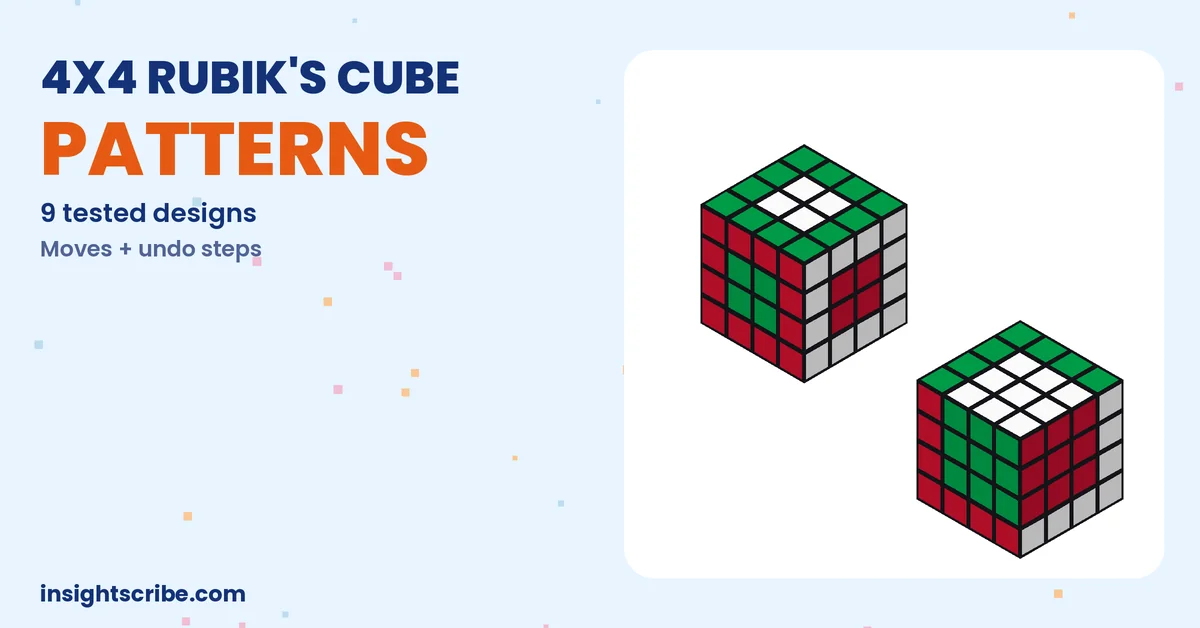
4×4 Rubik’s Cube Patterns: 9 Tested Designs With Moves and Undo Steps
Quick answer: The easiest 4×4 Rubik’s Cube pattern is Stripes. Start from a solved cube and do R2 Lw2 L2: three half turns give you two-colour stripes on four faces. This page has nine tested 4×4 patterns, from stripes and checkerboards to dots, nested squares and a 3×3 in a 4×4, each with its moves and the exact moves to undo it.
The 4×4 cube (sold by Rubik’s as the Rubik’s Revenge) has no fixed centres and two inner layers on every axis, so it makes designs a 3×3 cannot. We ran every sequence on this page through a computer model of a 4×4 cube, checked the picture it makes, and confirmed that the undo moves bring the cube back to solved. The three tables under each pattern show the top, front and right faces, using the colours of a standard cube held with white on top and green in front.
Key takeaways
- Start every pattern from a fully solved 4×4.
- Stripes (
R2 Lw2 L2) is the quickest design: 3 moves. - Most patterns use only half turns, so there is nothing to get wrong about direction.
- To undo any pattern, reverse the order and flip each turn. We list the undo moves for all nine.
- The same letters on a 5×5 can give a different picture, so do not copy 4×4 moves onto a bigger cube.
Contents
- 4×4 notation in one minute
- All nine patterns at a glance
- Stripes
- Double stripes
- Checkerboard top and bottom
- Corners and centers
- Dots
- Nested squares
- Tetris
- 3×3 in a 4×4
- Four-face checkerboard
- How to undo a pattern
- Tips for clean results
- FAQ
4×4 Cube Notation in One Minute
The six face letters are the same as on a 3×3: R (right), L (left), U (up), D (down), F (front) and B (back). A plain letter turns only the outer layer on that side a quarter turn clockwise, a prime (‘) means counterclockwise, and a 2 means a half turn. If you are new to this, our Rubik’s Cube notation for kids guide explains the basics with pictures.
Big cubes add one idea: a small w after the letter means “wide”. Rw turns the two right layers together, and 3Rw turns the three right layers together. The World Cube Association’s official notation (Regulations, Article 12) covers outer face turns, these wide turns and whole-cube rotations. It has no symbol for turning a single inner layer, so this page builds that move from the official ones: Lw2 L2 half-turns the left two layers, then half-turns the outer left layer back, which leaves only the second layer from the left turned. Many cubers write that same move as 2L2. We checked on our model that Lw2 L2 and 2L2 give the same cube.
All Nine Patterns at a Glance
| Pattern | Moves | Uses inner layers |
|---|---|---|
| Stripes | 3 | Yes |
| Double stripes | 6 | Yes |
| Checkerboard top and bottom | 9 | Yes |
| Corners and centers | 6 | No |
| Dots | 8 | No |
| Nested squares | 14 | No |
| Tetris | 8 | No |
| 3×3 in a 4×4 | 15 | No |
| Four-face checkerboard | 12 | Yes |
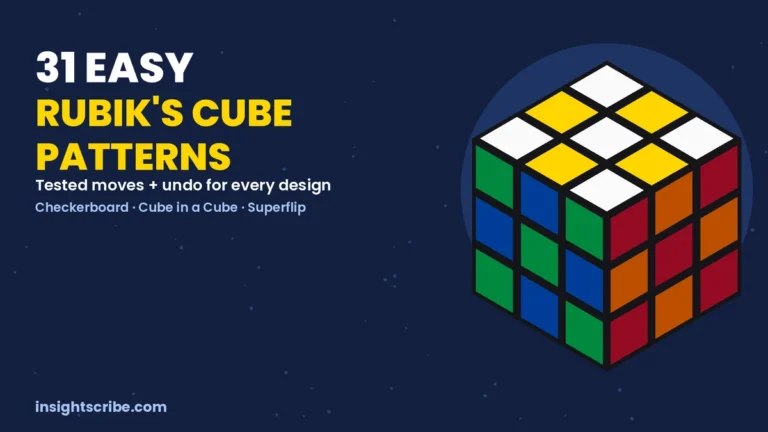
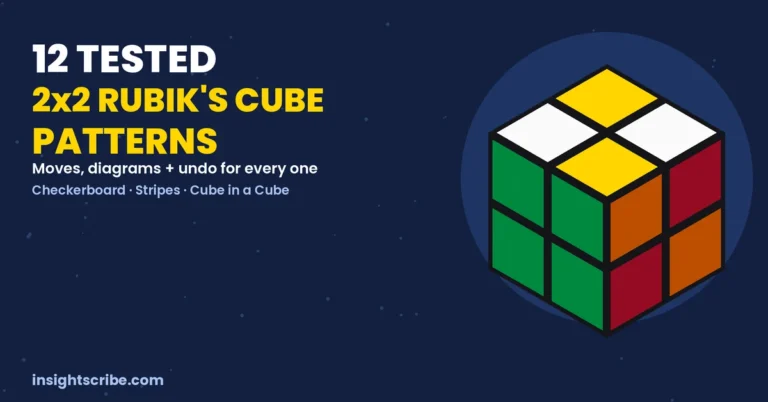
Start with Stripes, move on to Dots, and save the Four-face checkerboard for last. If you want designs for other cubes, try our 31 easy 3×3 Rubik’s Cube patterns or the 12 tested 2×2 patterns.
1. Stripes
The simplest 4×4 pattern. The top, bottom, front and back faces get two-colour stripes, while the left and right faces stay solid.
Moves (3): R2 Lw2 L2
| Top (U) | Front (F) | Right (R) |
|---|---|---|
| ⬜🟨⬜🟨 ⬜🟨⬜🟨 ⬜🟨⬜🟨 ⬜🟨⬜🟨 | 🟩🟦🟩🟦 🟩🟦🟩🟦 🟩🟦🟩🟦 🟩🟦🟩🟦 | 🟥🟥🟥🟥 🟥🟥🟥🟥 🟥🟥🟥🟥 🟥🟥🟥🟥 |
Undo: L2 Lw2 R2
Only three moves, and a great first pattern because you can see the inner layer doing its job: Lw2 L2 half-turns the left two layers and then half-turns the outer left layer back, so only the second layer from the left is left turned.
2. Double stripes
Every face is striped: vertical stripes on the top, bottom, front and back, and horizontal stripes on the left and right.
Moves (6): R2 Lw2 L2 U2 Dw2 D2
| Top (U) | Front (F) | Right (R) |
|---|---|---|
| 🟨⬜🟨⬜ 🟨⬜🟨⬜ 🟨⬜🟨⬜ 🟨⬜🟨⬜ | 🟩🟦🟩🟦 🟩🟦🟩🟦 🟩🟦🟩🟦 🟩🟦🟩🟦 | 🟧🟧🟧🟧 🟥🟥🟥🟥 🟧🟧🟧🟧 🟥🟥🟥🟥 |
Undo: D2 Dw2 U2 L2 Lw2 R2
The stripes pattern, then the same trick again on the up/down axis (U2 Dw2 D2). Six moves, all half turns.
3. Checkerboard top and bottom
The top and bottom faces become true checkerboards, and the four side faces are striped.
Moves (9): R2 Lw2 L2 U2 Dw2 D2 F2 Bw2 B2
| Top (U) | Front (F) | Right (R) |
|---|---|---|
| 🟨⬜🟨⬜ ⬜🟨⬜🟨 🟨⬜🟨⬜ ⬜🟨⬜🟨 | 🟦🟩🟦🟩 🟦🟩🟦🟩 🟦🟩🟦🟩 🟦🟩🟦🟩 | 🟧🟧🟧🟧 🟥🟥🟥🟥 🟧🟧🟧🟧 🟥🟥🟥🟥 |
Undo: B2 Bw2 F2 D2 Dw2 U2 L2 Lw2 R2
Add one more pair of inner-layer half turns (F2 Bw2 B2) to the double stripes. Nine half turns in all.
4. Corners and centers
On every face the four corners and the 2×2 centre block share one colour, and the edge squares carry a second colour.
Moves (6): R2 L2 U2 D2 F2 B2
| Top (U) | Front (F) | Right (R) |
|---|---|---|
| ⬜🟨🟨⬜ 🟨⬜⬜🟨 🟨⬜⬜🟨 ⬜🟨🟨⬜ | 🟩🟦🟦🟩 🟦🟩🟩🟦 🟦🟩🟩🟦 🟩🟦🟦🟩 | 🟥🟧🟧🟥 🟧🟥🟥🟧 🟧🟥🟥🟧 🟥🟧🟧🟥 |
Undo: B2 F2 D2 U2 L2 R2
Six half turns of the outer layers, no inner layers needed. Because only outer layers move, the 2×2 centre blocks stay put and the other pieces swap around them.
5. Dots
Every face shows a solid frame of one colour around a 2×2 centre block of another colour, like a dot on each side.
Moves (8): U D' R L' F B' U D'
| Top (U) | Front (F) | Right (R) |
|---|---|---|
| 🟩🟩🟩🟩 🟩⬜⬜🟩 🟩⬜⬜🟩 🟩🟩🟩🟩 | 🟥🟥🟥🟥 🟥🟩🟩🟥 🟥🟩🟩🟥 🟥🟥🟥🟥 | ⬜⬜⬜⬜ ⬜🟥🟥⬜ ⬜🟥🟥⬜ ⬜⬜⬜⬜ |
Undo: D U' B F' L R' D U'
Eight quarter turns, only outer faces. On a 3×3 the same moves make a single dot; on a 4×4 the dot becomes a 2×2 square.
6. Nested squares
Each face shows three colours: corners, edges and a centre block, like squares inside a square.
Moves (14): U D' R L' F B' U D' R2 L2 U2 D2 F2 B2
| Top (U) | Front (F) | Right (R) |
|---|---|---|
| 🟩🟦🟦🟩 🟦⬜⬜🟦 🟦⬜⬜🟦 🟩🟦🟦🟩 | 🟥🟧🟧🟥 🟧🟩🟩🟧 🟧🟩🟩🟧 🟥🟧🟧🟥 | ⬜🟨🟨⬜ 🟨🟥🟥🟨 🟨🟥🟥🟨 ⬜🟨🟨⬜ |
Undo: B2 F2 D2 U2 L2 R2 D U' B F' L R' D U'
Do Dots, then add the six half turns of Corners and centers (14 moves). Together they put three colours on every face.
7. Tetris
Blocks of three colours that interlock like Tetris pieces on every face.
Moves (8): L R F B U' D' L' R'
| Top (U) | Front (F) | Right (R) |
|---|---|---|
| 🟩🟩🟩🟦 🟩⬜⬜🟦 🟩⬜⬜🟦 🟩🟦🟦🟦 | 🟥🟧🟧🟧 🟥🟩🟩🟧 🟥🟩🟩🟧 🟥🟥🟥🟧 | ⬜🟨🟨🟨 ⬜🟥🟥🟨 ⬜🟥🟥🟨 ⬜⬜⬜🟨 |
Undo: R L D U B' F' R' L'
Eight quarter turns of outer layers. These are the same moves that make the Tetris pattern in our 3×3 patterns list, so if you know that one you already know this one.
8. 3×3 in a 4×4
A 3×3 block of colour sits in one corner so the cube looks like a smaller cube inside the big one.
Moves (15): F L F U' R U F2 L2 U' L' B D' B' L2 U
| Top (U) | Front (F) | Right (R) |
|---|---|---|
| 🟩🟩🟩🟩 🟩⬜⬜⬜ 🟩⬜⬜⬜ 🟩⬜⬜⬜ | 🟥🟩🟩🟩 🟥🟩🟩🟩 🟥🟩🟩🟩 🟥🟥🟥🟥 | 🟥🟥🟥⬜ 🟥🟥🟥⬜ 🟥🟥🟥⬜ ⬜⬜⬜⬜ |
Undo: U' L2 B D B' L U L2 F2 U' R' U F' L' F'
The longest sequence here at 15 moves, all outer layers. Go slowly and check the front-right-top corner after every few moves.
9. Four-face checkerboard
The front, back, left and right faces are true checkerboards while the top and bottom stay solid.
Moves (12): 3Rw2 Rw2' R2 3Fw2 Fw2' F2 3Rw2 Rw2' R2 3Dw2 Dw2' D2
| Top (U) | Front (F) | Right (R) |
|---|---|---|
| ⬜⬜⬜⬜ ⬜⬜⬜⬜ ⬜⬜⬜⬜ ⬜⬜⬜⬜ | 🟦🟩🟦🟩 🟩🟦🟩🟦 🟦🟩🟦🟩 🟩🟦🟩🟦 | 🟥🟧🟥🟧 🟧🟥🟧🟥 🟥🟧🟥🟧 🟧🟥🟧🟥 |
Undo: D2 Dw2 3Dw2 R2 Rw2 3Rw2 F2 Fw2 3Fw2 R2 Rw2 3Rw2
The hardest to type but the most satisfying. Each trio such as 3Rw2 Rw2' R2 half-turns the first and third layers from the right and leaves the second layer alone. The sequence is the one published on the Speedsolving wiki, and we checked it on our model.
How to Undo a 4×4 Pattern
There are two ways back to a solved cube. The slow way is to solve the 4×4 normally. The fast way is to undo the pattern: write the moves down, read them from right to left, and turn each one the opposite way. R becomes R’, R’ becomes R, and any 2 stays a 2. For Dots, U D' R L' F B' U D' becomes D U' B F' L R' D U'. Always do the undo straight after the pattern, before you turn anything else.
Tips for Clean Results
- Hold the cube the same way every time. White on top and green in front matches the colours shown here. If you hold it differently the shape is the same but the colours change.
- Finish every half turn. A layer stopped at 45 degrees is the most common reason a pattern comes out wrong. Straighten each layer before the next move.
- Read the wide moves twice.
Lw2andL2look alike, but one moves two layers and the other moves one. - Take photos. Because every undo list is exact, you can show off the pattern and still go straight back to solved.
- Do not copy these moves to other cubes. A 5×5 has an extra layer, so the same letters can make a different picture (see the FAQ).
More cube guides live in the Rubik’s puzzles collection.
4×4 Rubik’s Cube Patterns FAQ
What is the easiest 4×4 Rubik’s Cube pattern?
Stripes: R2 Lw2 L2 from a solved cube. It takes three half turns and gives two-colour stripes on four faces.
Do 4×4 patterns start from a solved cube?
Yes. Every sequence on this page assumes you start from a fully solved 4×4. If your cube is scrambled, solve it first, or the pattern will not appear.
How do I undo a 4×4 pattern?
Do the moves in reverse order and flip every turn: R becomes R’, R’ becomes R, and half turns such as R2 stay the same. Each pattern on this page lists its undo moves, and we checked that every undo returns the cube to solved.
Why are 4×4 patterns different from 3×3 patterns?
A 4×4 has no single middle layer and no fixed centres, and its inner layers can be turned on their own. Some 3×3 pattern moves still work on a 4×4, like Tetris and Dots, but patterns built on the middle slice need new sequences.
Can I use these patterns on a 5×5 cube?
Not reliably. The letters turn the same layers but a 5×5 has an extra layer, so the picture changes. On our model the Dots moves still make a centred block on a 5×5, but the Stripes moves do not make stripes. Check each pattern on a model or a pattern list for your cube size.