Family Trivia Questions & Answers for Game Night
Family trivia works best when children and adults both get chances to shine. These rounds mix easy wins with gradually tougher questions across animals, science, geography, history and culture so one age group does not dominate the game.
Keep playing with trivia questions for kids, trivia questions for adults, Trivia hub.
How to Play
- Read the full question before anyone answers.
- Award 1 point for each correct answer.
- Rotate the reader so one person is not always hosting.
- Use the final round as a tie-breaker if the scores are close.
Kids Can Win This Round
Q1. How many days are in a week?
Answer: Seven. Why: A week has seven days.
Q2. What animal says “moo”?
Answer: A cow. Why: Cows communicate with vocal sounds commonly called moos.
Q3. What color do you get when you mix red and yellow paint?
Answer: Orange. Why: In basic paint mixing, red and yellow make orange.
Q4. How many sides does a triangle have?
Answer: Three. Why: A triangle has three sides.
Q5. What is a baby dog called?
Answer: A puppy. Why: Puppy is the common term for a young dog.
Q6. What is the closest star to Earth?
Answer: The Sun. Why: The Sun is our nearest star.
Q7. What season comes after winter?
Answer: Spring. Why: Spring follows winter in the standard four-season cycle.
Q8. How many minutes are in an hour?
Answer: 60. Why: One hour equals 60 minutes.
Animals & Nature
Q9. How many legs does a spider have?
Answer: Eight. Why: Spiders are arachnids with four pairs of legs.
Q10. What is the tallest living land animal?
Answer: The giraffe. Why: Giraffes are taller than any other living land animal.
Q11. Which bird cannot fly and is the largest living bird?
Answer: The ostrich. Why: Ostriches are flightless and are the world’s largest living birds.
Q12. What is a baby kangaroo called?
Answer: A joey. Why: Young kangaroos continue developing in the pouch.
Q13. What food makes up most of a giant panda’s diet?
Answer: Bamboo. Why: Giant pandas eat large amounts of bamboo.
Q14. How many arms does an octopus have?
Answer: Eight. Why: Octopuses have eight arms.
Q15. Which insect makes honey?
Answer: The honeybee. Why: Honeybees collect nectar from flowers and process it into honey.
Q16. Is a dolphin a fish or a mammal?
Answer: A mammal. Why: Dolphins breathe air with lungs and nurse their young.
Science & Space
Q17. Which planet is known as the Red Planet?
Answer: Mars. Why: Iron minerals give Mars its reddish appearance.
Q18. How many planets are in our solar system?
Answer: Eight. Why: There are eight recognized planets.
Q19. What force pulls objects toward Earth?
Answer: Gravity. Why: Gravity attracts masses toward one another.
Q20. What common substance has the formula H2O?
Answer: Water. Why: Water contains hydrogen and oxygen.
Q21. What is the largest planet in our solar system?
Answer: Jupiter. Why: Jupiter is the largest planet by mass and diameter.
Q22. What gas makes up most of Earth’s atmosphere?
Answer: Nitrogen. Why: Nitrogen makes up about 78 percent of dry air.
Q23. What organ pumps blood through the human body?
Answer: The heart. Why: The heart circulates blood through the body’s blood vessels.
Q24. What do we call animals that eat only plants?
Answer: Herbivores. Why: Herbivores feed on plant material.
World & History
Q25. What is the capital of the United States?
Answer: Washington, D.C. Why: It is the seat of the U.S. federal government.
Q26. Which country contains the Great Wall?
Answer: China. Why: The Great Wall stretches across northern China.
Q27. Who was the first president of the United States?
Answer: George Washington. Why: Washington took office in 1789.
Q28. In which country are the Pyramids of Giza?
Answer: Egypt. Why: The pyramids are near Cairo.
Q29. What is the capital of France?
Answer: Paris. Why: Paris is the capital of France.
Q30. In what year did the Titanic sink?
Answer: 1912. Why: Titanic sank in the North Atlantic in April 1912.
Q31. Who painted the Mona Lisa?
Answer: Leonardo da Vinci. Why: The painting is held by the Louvre.
Q32. Which country gave the Statue of Liberty to the United States?
Answer: France. Why: The statue was a gift from the people of France.
Family Challenge Round
Q33. What is the smallest sovereign state in the world?
Answer: Vatican City. Why: It is surrounded by Rome, Italy.
Q34. Which element has the chemical symbol Au?
Answer: Gold. Why: Au comes from the Latin word aurum.
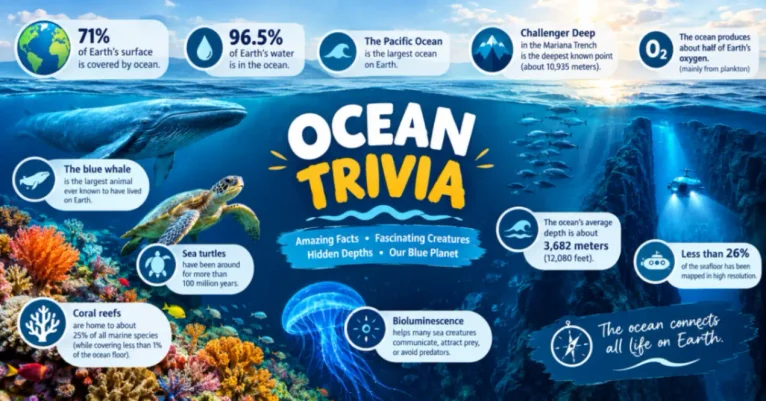
Q35. What is the largest ocean on Earth?
Answer: The Pacific Ocean. Why: The Pacific is Earth’s largest ocean basin.
Q36. Which Shakespeare play is about two young lovers from feuding families?
Answer: Romeo and Juliet. Why: The tragedy centers on the Montague and Capulet families.
Q37. What is the smallest bone in the human body?
Answer: The stapes. Why: The stapes is one of the tiny bones of the middle ear.
Q38. What is the capital of Australia?
Answer: Canberra. Why: Canberra is Australia’s national capital.
Q39. What instrument usually has 88 keys?
Answer: The piano. Why: A standard full-size piano has 88 keys.
Q40. What is the chemical symbol for hydrogen?
Answer: H. Why: Hydrogen is element number 1 on the periodic table.
Score Guide
- 0–15: Good warm-up — pick a favorite category and try again.
- 16–28: Strong general knowledge.
- 29–35: Excellent family quiz-night form.
- 36–40: Outstanding — nearly every round was a win.
Reliable Sources
Stable factual claims were checked against established science, government, museum or educational references:
- NASA Science — Solar System Facts
- Smithsonian National Zoo — Animal Facts
- U.S. National Archives — George Washington
- UNESCO World Heritage Centre
Family Trivia FAQ
How do I make family trivia fair for different ages? Mix easy and harder rounds, rotate who answers first, and use mixed-age teams when the age gap is large.
What topics work well for family trivia? Animals, science, geography, history and everyday culture are broad enough for several generations to contribute.