15 Solar and Lunar Eclipse Trivia Questions With Answers
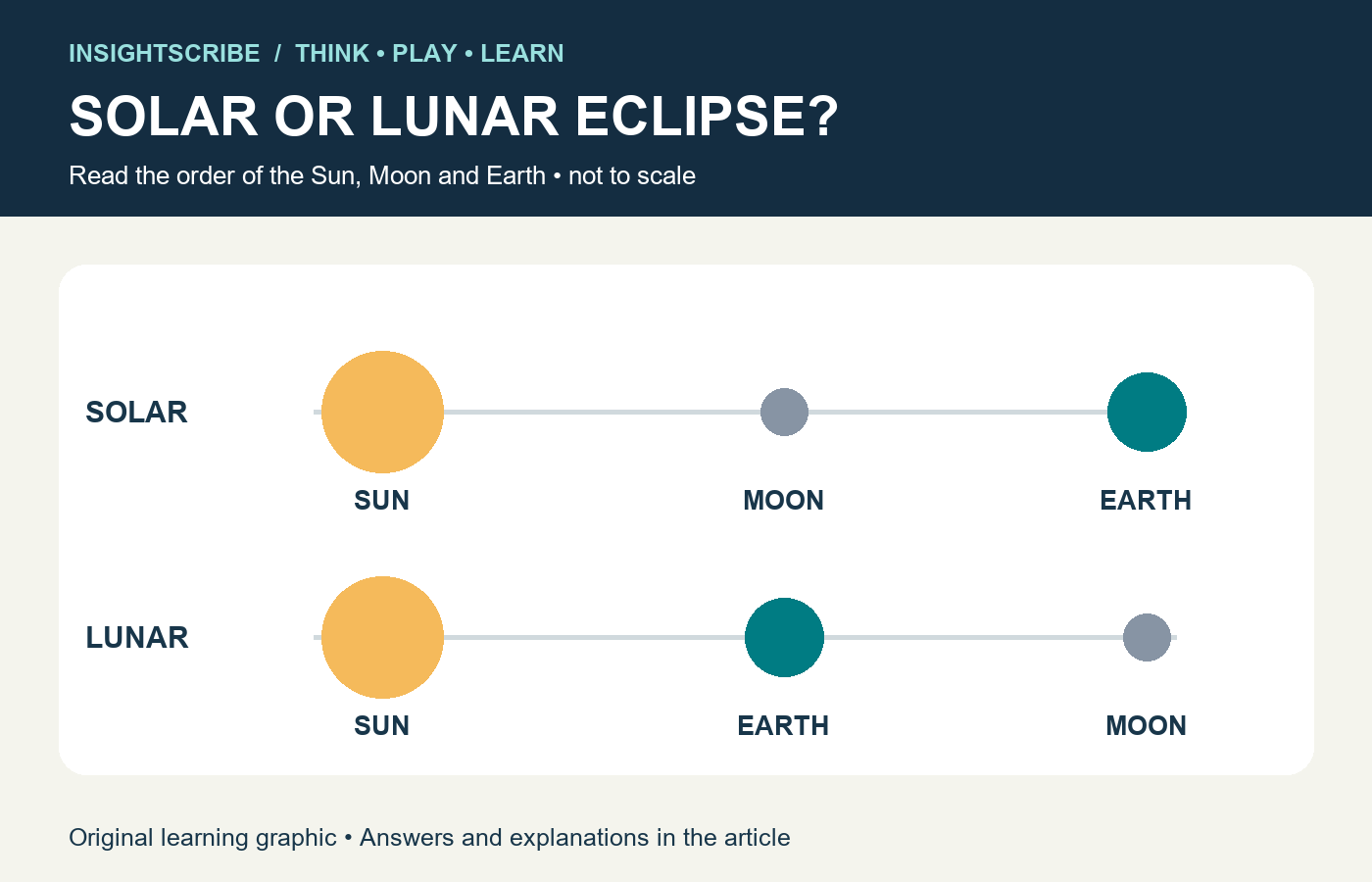
Quick answer: A solar eclipse puts the Moon between the Sun and Earth; a lunar eclipse puts Earth between the Sun and Moon. This 15-question quiz tests that difference, lunar phases and shadows. Give one point per correct answer, then use the explanation to settle any disagreement.
Solar-viewing safety: This is a quiz, not a viewing setup. Never look directly at the Sun without proper solar-viewing protection. Ordinary sunglasses are not a substitute. Children need adult supervision; follow the linked NASA safety guidance, especially for cameras, binoculars and telescopes.
Round 1: which eclipse?
Which object is in the middle during a solar eclipse: Earth or the Moon?
Show answer and explanation
The Moon. It passes between Earth and the Sun.
Which object casts its shadow on the Moon during a lunar eclipse?
Show answer and explanation
Earth. The Moon moves through Earth’s shadow.
Which phase is required for a solar eclipse: new moon or full moon?
Show answer and explanation
New moon. The Moon is on the Sun-facing side of Earth.
Which phase is required for a lunar eclipse?
Show answer and explanation
Full moon. The Moon is opposite the Sun in our sky.
True or false: every new moon produces a solar eclipse.
Show answer and explanation
False. The Moon’s tilted orbit usually carries its shadow above or below Earth.
Round 2: shadows and appearances
What is the name of the darkest central part of a shadow?
Show answer and explanation
Umbra. For a total lunar eclipse, the Moon enters Earth’s umbra.
What is the name of the lighter outer shadow region?
Show answer and explanation
Penumbra. Only part of the sunlight is blocked there.
In which solar eclipse does the Moon cover the Sun’s entire bright face for observers inside the narrow totality path?
Show answer and explanation
A total solar eclipse. The appearance depends on where the observer is.
What is an annular solar eclipse often nicknamed because of its bright appearance?
Show answer and explanation
A ring of fire. The Moon appears too small to cover the Sun’s whole face; the remaining ring is still dangerously bright.
What is the Sun’s outer atmosphere, visible during a total solar eclipse, called?
Show answer and explanation
The corona. It is normally overwhelmed by the much brighter solar surface.
Round 3: explain the science
Why can the Moon turn reddish during a total lunar eclipse?
Show answer and explanation
Sunlight passes through Earth’s atmosphere before reaching the Moon. Earth’s atmosphere changes and redirects the light; the color is not the Moon producing its own red light.
Which can be seen across much of Earth’s night side: a lunar eclipse or a solar eclipse’s totality?
Show answer and explanation
A lunar eclipse. Solar totality follows a much narrower path on Earth’s surface.
Is a lunar eclipse ordinarily safe to watch with unaided eyes?
Show answer and explanation
Yes. You are looking at the Moon, not directly at the Sun.
Can ordinary dark sunglasses replace proper solar eclipse glasses?
Show answer and explanation
No. Sunglasses do not provide the required protection for looking at the Sun.
Why do eclipses happen only at some new or full moons?
Show answer and explanation
The Moon’s orbit is tilted relative to Earth’s orbit around the Sun. The three bodies must line up closely enough for a shadow to reach the right place.
Host notes and tie-breaker
Read each question before showing an answer. Accept scientifically equivalent wording: for example, “the Moon comes between us and the Sun” answers question 1. For a tie, ask teams to draw both alignments and label the object in the middle. Score the geometry rather than the quality of the drawing. Do not use an outdoor Sun-viewing challenge as a tie-breaker.
What does the score mean?
13–15: strong eclipse vocabulary; 9–12: revisit shadows and phases; 0–8: redraw the two alignments and try again. These bands are game suggestions, not a standardized assessment.
More science questions
Continue with science trivia or space trivia. Future eclipse dates are intentionally excluded so the quiz does not depend on a changing calendar.
Sources and review notes
Reviewed October 20, 2026. Quiz wording and explanations are written for this page; factual checks use the linked references.