Types of Rubik’s Cubes for Kids: Which Cube to Start With
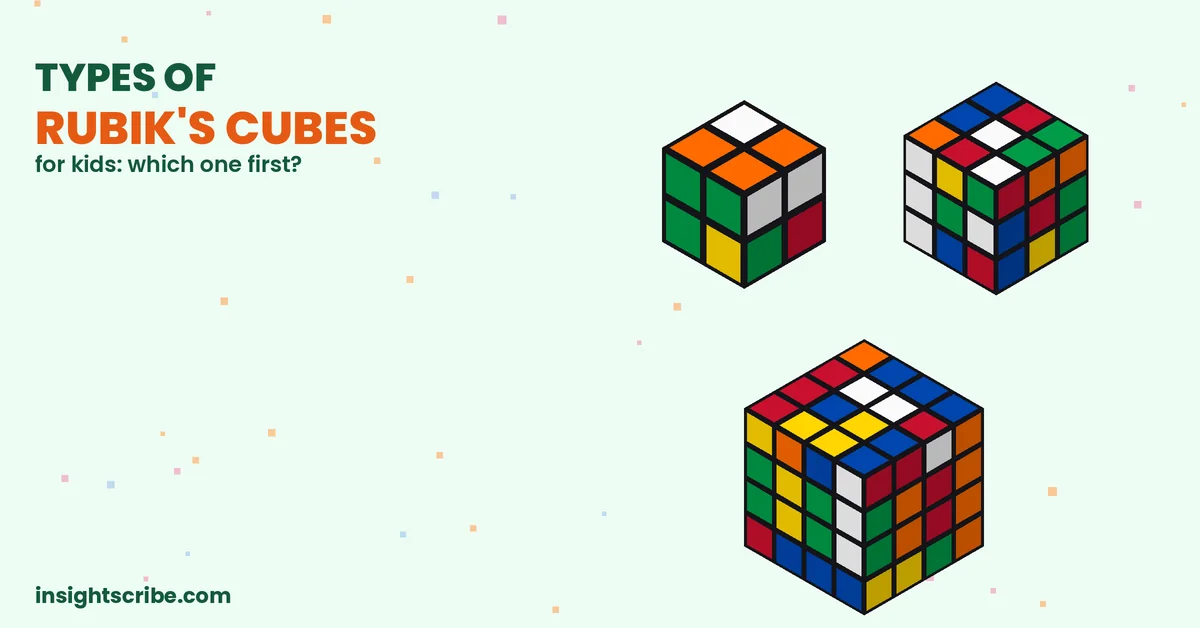
Quick answer: The main types of Rubik’s Cube for kids are the 2×2 (8 pieces), the classic 3×3 (26 pieces), the 4×4 (56 pieces) and the 5×5, plus the shaped puzzles Pyraminx, Skewb and Megaminx. For a beginner, we suggest starting with the 2×2 or the classic 3×3. Official Rubik’s 2×2, 3×3 and 4×4 boxes are labelled for ages 8 and up.
Walk into a toy shop and you will find lots of cubes that look similar and play very differently. This guide explains each type in plain words, with piece counts, how many positions it has and where to begin. Piece counts for the 2×2 to 5×5 come from a computer model of each cube. The other numbers come from published sources listed at the end.
Key takeaways
- A bigger cube means more pieces: 8 (2×2), 26 (3×3), 56 (4×4) and 98 (5×5).
- Our suggestion for most children: start with a 2×2 or a 3×3, then try a Pyraminx or a 4×4.
- All the puzzles in this guide are official World Cube Association events, so any of them can be used in a real competition.
- Official Rubik’s 2×2, 3×3 and 4×4 boxes say ages 8 and up. Check the box for any other puzzle.
Contents
- Comparison table
- 2×2 cube
- 3×3 cube
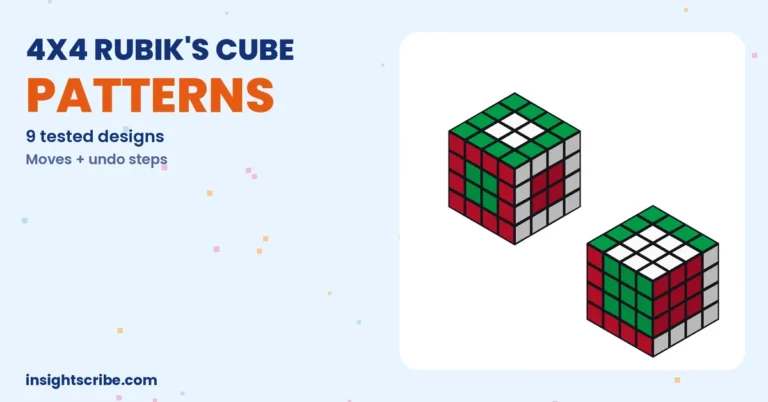
- 4×4 cube
- Piece counts
- 5×5 and bigger
- Pyraminx
- Skewb
- Megaminx
- Which one should you pick?
- FAQ
Types of Rubik’s Cube at a Glance
| Puzzle | Pieces | Possible positions | Official WCA event |
|---|---|---|---|
| 2×2 (Pocket Cube) | 8 | 3,674,160 | Yes |
| 3×3 (the classic) | 26 | about 43 quintillion (43,252,003,274,489,856,000) | Yes |
| 4×4 (Rubik’s Revenge) | 56 | about 7.4 x 1045 | Yes |
| 5×5 (Professor’s Cube) | 98 | extremely many | Yes |
| Pyraminx | 14 | 933,120 (not counting the tips) | Yes |
| Skewb | 14 | 3,149,280 | Yes |
| Megaminx | 62 | about 1.01 x 1068 | Yes |
The Pyraminx has 14 pieces: 4 tips, 4 corner pieces and 6 edges. The Skewb has 14 pieces: 8 corners and 6 centres. The Megaminx has 62: 12 centres, 20 corners and 30 edges. A position is one way the pieces can be arranged.
2×2 Cube (Pocket Cube)
The 2×2 has 8 corner pieces and nothing else, so it has 24 stickers. There are 3,674,160 possible positions, and every one can be solved in at most 11 moves. It was invented in 1970 by Larry D. Nichols, who built it with magnets. It is small enough to carry in a pocket, which is why it is also called the Pocket Cube. See our 12 tested 2×2 patterns for ideas.
3×3 Cube (The Classic)
The one most people picture. It has 26 pieces: 8 corners, 12 edges and 6 centres, with 54 stickers in all. The centres only spin and never swap, which sets the colour of each face. It was invented in 1974 by the Hungarian professor Ernő Rubik, and it has about 43 quintillion positions. Yet any scramble can be solved in 20 moves or fewer, counting a half turn as one move. Learn the move letters with our notation guide for kids.
4×4 Cube (Rubik’s Revenge)
The 4×4 has 56 pieces: 8 corners, 24 edges and 24 centres, and 96 stickers. It has no fixed centre piece, so the centres can be rearranged. It has about 7.4 x 1045 positions. We suggest learning the 3×3 first.
How the Piece Counts Add Up
| Cube | Corners | Edges | Centres | Pieces | Stickers |
|---|---|---|---|---|---|
| 2×2 | 8 | 0 | 0 | 8 | 24 |
| 3×3 | 8 | 12 | 6 | 26 | 54 |
| 4×4 | 8 | 24 | 24 | 56 | 96 |
| 5×5 | 8 | 36 | 54 | 98 | 150 |
Every cube has 8 corners. Each added layer adds more edges and centres, so the 5×5 has 98 pieces while the 2×2 has only 8. All four rows come from our cube model.
5×5 and Bigger
The 5×5 has 98 pieces and 150 stickers. The 6×6 and 7×7 are also official events. Bigger cubes use the same ideas with more layers, so most people try them after the 3×3 and 4×4.
Pyraminx
A pyramid with four faces, made and patented by Uwe Mèffert and introduced by Tomy Toys of Japan in 1981. It has 14 pieces (4 tips, 4 corner pieces and 6 edges) and 933,120 positions, not counting the tips. Any position can be solved in at most 11 twists. We suggest it as a second puzzle after a cube.
Skewb
A cube that turns around its corners instead of its faces. It has 14 pieces: 6 centres and 8 corners, and 3,149,280 positions. Every position can be solved in at most 11 moves. It was invented by Tony Durham, and each twist affects all six faces.
Megaminx
A twelve-sided dodecahedron with 62 pieces: 12 centres, 20 corners and 30 edges. It has about 1.01 x 1068 positions. It is the biggest of the shaped puzzles in this guide.
Which One Should You Pick?
- Brand new to cubes: a 2×2 or a classic 3×3. The 2×2 has the fewest pieces, so it is a gentle start.
- Solved a 3×3 and want more: a Pyraminx, a Skewb or a 4×4.
- Love long, calm puzzles: a Megaminx.
- Buying a gift: check the age on the box. Official Rubik’s 2×2, 3×3 and 4×4 boxes say ages 8 and up.
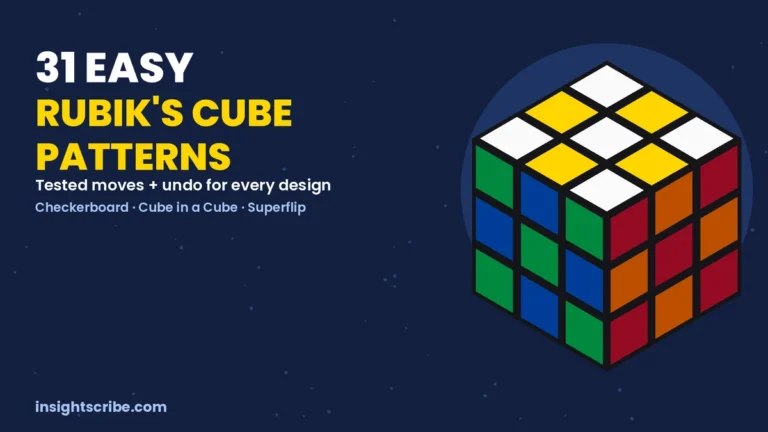
These are our suggestions, not rules. Once you have a cube, make designs from our 31 easy Rubik’s Cube patterns, and see every guide in the Rubik’s puzzles collection.
Sources
- Wikipedia: Pocket Cube, Rubik’s Cube, Rubik’s Revenge, Pyraminx, Megaminx and Skewb.
- Jaap’s Puzzle Page: Pyraminx and Skewb piece and position counts.
- World Cube Association Regulations, Regulation 9b: the list of official events.
- Spin Master’s Rubik’s product pages: ages 8 and up for the 2×2, 3×3 and 4×4.
- Our own cube model: piece and sticker counts for the 2×2, 3×3, 4×4 and 5×5, and the position formulas for the 2×2, 3×3, 4×4 and Pyraminx.
Types of Rubik’s Cube FAQ
Which Rubik’s Cube is best for a beginner?
The classic 3×3 is the one most people want to learn, and the 2×2 is a smaller first step with only 8 pieces. Official Rubik’s 2×2, 3×3 and 4×4 boxes are all labelled for ages 8 and up. Pick the 2×2 for a quick start or the 3×3 if the child already loves puzzles.
What is the difference between a 2×2 and a 3×3 Rubik’s Cube?
A 2×2 has only 8 corner pieces, with no edges or centres. A 3×3 has 26 pieces: 8 corners, 12 edges and 6 centres. The 2×2 has about 3.7 million positions, the 3×3 about 43 quintillion.
Is a Pyraminx easier than a Rubik’s Cube?
It has far fewer positions (933,120, not counting the tips) than a 3×3, and every position can be solved in at most 11 twists. That is a big difference, but it still needs its own steps, so it is not a free pass.
Are all these puzzles official competition events?
Yes. The World Cube Association lists the 2×2, 3×3, 4×4, 5×5, 6×6, 7×7, Pyraminx, Skewb, Megaminx, Clock and Square-1 among its official events.
How old do you have to be to use a Rubik’s Cube?
Official Rubik’s 2×2, 3×3 and 4×4 boxes say ages 8 and up. Many younger children enjoy turning a cube, and the label is a guide, so check the box of any puzzle you buy.