Trivia Questions for Adults: Fun General Knowledge Quiz
These trivia questions for adults are built for game nights, parties and casual quiz rounds where the group wants a mix of familiar facts and a few genuinely challenging questions. The set covers history, science, geography, culture and general knowledge without relying on trick wording.
Keep playing with hard trivia questions, family trivia questions, Trivia hub.
How to Play
- Read the full question before anyone answers.
- Award 1 point for each correct answer.
- Rotate the reader so one person is not always hosting.
- Use the final round as a tie-breaker if the scores are close.
Warm-Up Trivia for Adults
Q1. What is the capital of France?
Answer: Paris. Why: Paris is the capital and largest city of France.
Q2. Which planet is the largest in our solar system?
Answer: Jupiter. Why: Jupiter is the largest planet by both mass and diameter.
Q3. How many players from one team are on the field in soccer at a time, including the goalkeeper?
Answer: Eleven. Why: The Laws of the Game allow 11 players, one of whom is the goalkeeper.
Q4. What is the chemical symbol for gold?
Answer: Au. Why: The symbol comes from the Latin word aurum.
Q5. Who was the first president of the United States?
Answer: George Washington. Why: Washington served from 1789 to 1797.
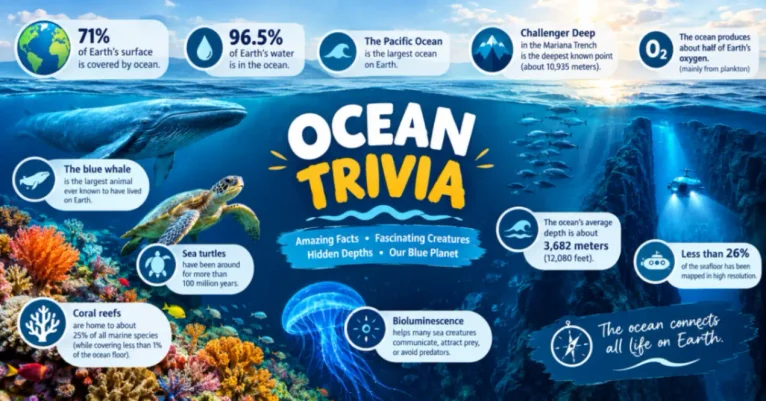
Q6. Which ocean is the largest on Earth?
Answer: The Pacific Ocean. Why: The Pacific is Earth’s largest and deepest ocean basin.
Q7. What is the name of the process plants use to convert light energy into chemical energy?
Answer: Photosynthesis. Why: Plants use light, carbon dioxide and water to make sugars.
Q8. Which instrument has a standard modern keyboard of 88 keys?
Answer: The piano. Why: A standard full-size piano has 52 white keys and 36 black keys.
History & Culture
Q9. In what year did World War II end?
Answer: 1945. Why: The war ended in Europe in May and in the Pacific in September 1945.
Q10. Who painted the Mona Lisa?
Answer: Leonardo da Vinci. Why: The portrait is held by the Louvre Museum in Paris.
Q11. Which document was adopted by the Continental Congress on July 4, 1776?
Answer: The U.S. Declaration of Independence. Why: It announced the colonies’ separation from Great Britain.
Q12. Which ancient city was buried by Mount Vesuvius in 79 CE?
Answer: Pompeii. Why: Volcanic material preserved much of the Roman city.
Q13. Who wrote Pride and Prejudice?
Answer: Jane Austen. Why: The novel was first published in 1813.
Q14. Which empire built Machu Picchu?
Answer: The Inca Empire. Why: The site is in present-day Peru.
Q15. Which artist painted The Persistence of Memory?
Answer: Salvador Dalí. Why: The 1931 painting is closely associated with Surrealism.
Q16. Which composer wrote The Four Seasons?
Answer: Antonio Vivaldi. Why: The work is a set of four violin concertos.
Science & Nature
Q17. What is the largest organ of the human body?
Answer: The skin. Why: Skin is the body’s largest organ by surface area and mass.
Q18. Which blood cells carry most of the oxygen in human blood?
Answer: Red blood cells. Why: Hemoglobin in red blood cells binds oxygen.
Q19. What is the hardest naturally occurring mineral on the Mohs scale?
Answer: Diamond. Why: Diamond is rated 10 on the Mohs hardness scale.
Q20. What is the SI unit of electric resistance?
Answer: The ohm. Why: Its symbol is Ω, the Greek letter omega.
Q21. Which mammals are capable of true sustained flight?
Answer: Bats. Why: Other mammals such as flying squirrels glide rather than fly under power.
Q22. What is the most abundant gas in Earth’s atmosphere?
Answer: Nitrogen. Why: Nitrogen makes up about 78 percent of dry air.
Q23. What is the smallest prime number?
Answer: 2. Why: It is also the only even prime number.
Q24. Which organelle is often called the powerhouse of the cell?
Answer: The mitochondrion. Why: Mitochondria produce most of a eukaryotic cell’s ATP through cellular respiration.
Geography & World Knowledge
Q25. What is the smallest sovereign state in the world?
Answer: Vatican City. Why: It is an independent state surrounded by Rome, Italy.
Q26. What is the capital of Australia?
Answer: Canberra. Why: Canberra, not Sydney or Melbourne, is the national capital.
Q27. Which country contains the ancient city of Petra?
Answer: Jordan. Why: Petra was a major city of the Nabataean kingdom.
Q28. What is the largest hot desert in the world?
Answer: The Sahara. Why: The Sahara covers much of North Africa.
Q29. Which river flows through Budapest, Vienna and Belgrade?
Answer: The Danube. Why: The Danube crosses or borders multiple European countries.
Q30. What is the largest country in the world by area?
Answer: Russia. Why: Russia spans eastern Europe and northern Asia.
Q31. Which two countries share the longest international land border?
Answer: Canada and the United States. Why: The boundary includes the Alaska–Canada border.
Q32. What imaginary line is at 0 degrees latitude?
Answer: The Equator. Why: It divides Earth into the Northern and Southern Hemispheres.
Challenge Round
Q33. Which element has the chemical symbol W?
Answer: Tungsten. Why: The symbol comes from the older name wolfram.
Q34. What is the capital of Burkina Faso?
Answer: Ouagadougou. Why: Ouagadougou is the country’s capital and largest city.
Q35. Who formulated the three laws of planetary motion?
Answer: Johannes Kepler. Why: Kepler described how planets move in elliptical orbits.
Q36. Which sea is bounded mainly by ocean currents rather than land?
Answer: The Sargasso Sea. Why: It lies in the North Atlantic and is defined by surrounding currents.
Q37. What is the study of fungi called?
Answer: Mycology. Why: Mycology is a branch of biology.
Q38. Which empire was ruled by Mansa Musa in the 14th century?
Answer: The Mali Empire. Why: Mansa Musa is remembered for the wealth and influence of medieval Mali.
Q39. What is the deepest known point in Earth’s oceans called?
Answer: Challenger Deep. Why: It is located in the Mariana Trench.
Q40. Which novel begins with the line “Call me Ishmael”?
Answer: Moby-Dick. Why: Herman Melville’s novel was published in 1851.
Score Guide
- 0–15: Good warm-up — pick a favorite category and try again.
- 16–28: Strong general knowledge.
- 29–35: Excellent quiz-night form.
- 36–40: Outstanding — you handled nearly every round.
Reliable Sources
Stable factual claims were checked against established science, government, museum or educational references:
- NASA Science — Solar System Facts
- U.S. National Archives — Declaration of Independence
- USGS — Oceans and Seas
- National Human Genome Research Institute — Cells and DNA
Adult Trivia FAQ
What makes a good adult trivia question? It should have one clear answer, enough context to avoid ambiguity and a subject mix that rewards different kinds of knowledge.
How many questions should I use for game night? A short round can use 10–15 questions; a longer event can combine several category rounds.