Rubik’s Cube Mosaic Ideas for Kids: 5 Easy Pixel Art Designs
Quick answer: A Rubik’s Cube mosaic uses one cube for each square of a picture. Solve one face of each cube to a single colour, turn that face up, and lay the cubes in a grid. A 5 by 5 grid uses 25 cubes, and our five easy designs (heart, smiley face, rainbow stripes, little tree and flower) all fit in one.
Mosaics are a great way to use a pile of old cubes in a classroom, a family or a club, and they also give kids a reason to practise solving one face. Each design below is a small colour map, with the exact number of cubes you need in every colour. We built the maps in code so the counts add up to 25 every time, and each design uses six colours or fewer, because that is all a standard cube has.
Key takeaways
- One cube equals one square. Solve one face to a single colour and turn it face up.
- Any standard cube can show any of the six colours, so you do not need special cubes.
- All five templates here use a 5 by 5 grid, which is 25 cubes. That is a nice size for one class or a family with friends.
- Start with rainbow stripes or the heart. Add details such as the eyes of the smiley once you are confident.
Contents
- How to make a mosaic
- Heart
- Smiley face
- Rainbow stripes
- Little tree
- Flower
- All cube counts at a glance
- Classroom plan
- Choosing the size
- Tips and ideas
- FAQ
How to Make a Rubik’s Cube Mosaic
- Pick a design and count the cubes by colour using the lists below.
- Solve one face of each cube. A solved face is one single colour. On a 3×3 that means the centre colour with the four edge pieces and four corner pieces matching it. The other five faces can stay scrambled, because nobody sees them. Younger children can start with a 2×2 cube, where one face needs only four corners.
- Lay the cubes in a grid with the solved face up, following the colour map row by row. A tray or a box lid keeps the squares from sliding.
- Step back and look. The colour map becomes a picture. Take a photo, then turn the cubes back into a new design.
If you do not know how to solve a face yet, start with our Rubik’s Cube activities for kids, and learn the move letters in our notation guide for kids.
Mosaic 1: Heart
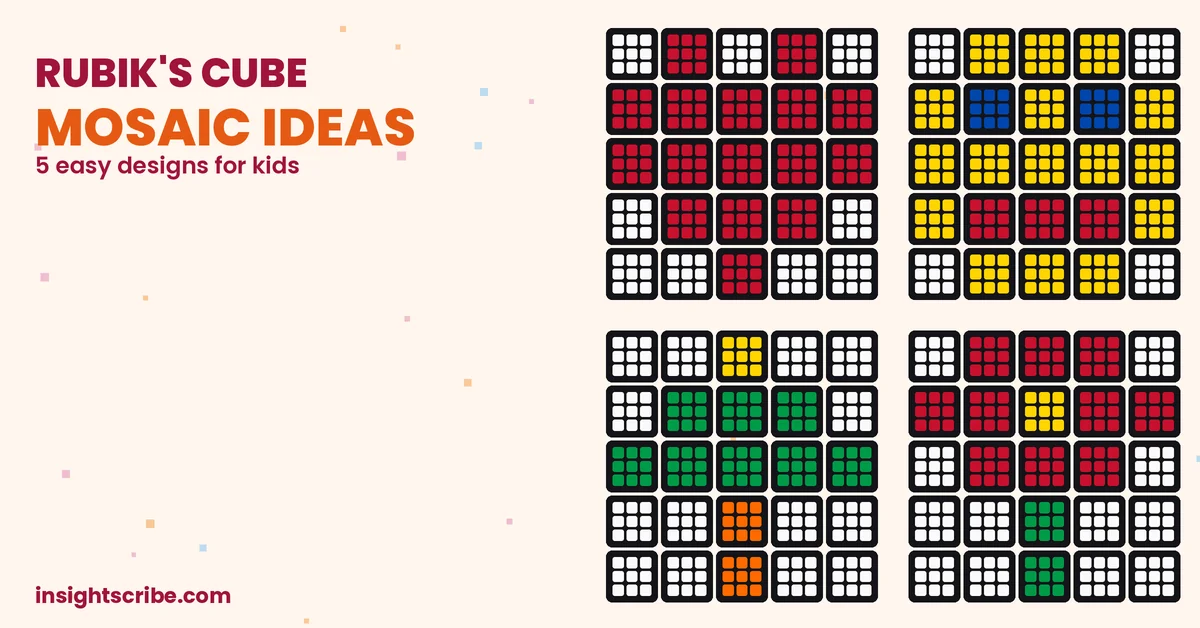
A red heart on a white background. The classic first mosaic. Perfect for Valentine’s Day or a Mother’s Day card.
| ⬜🟥⬜🟥⬜ |
| 🟥🟥🟥🟥🟥 |
| 🟥🟥🟥🟥🟥 |
| ⬜🟥🟥🟥⬜ |
| ⬜⬜🟥⬜⬜ |
You need 25 cubes: 9 white, 16 red.
Mosaic 2: Smiley face
A yellow face with blue eyes and a red smile. The two blue cubes are the eyes and the three red cubes are the smile.
| ⬜🟨🟨🟨⬜ |
| 🟨🟦🟨🟦🟨 |
| 🟨🟨🟨🟨🟨 |
| 🟨🟥🟥🟥🟨 |
| ⬜🟨🟨🟨⬜ |
You need 25 cubes: 4 white, 16 yellow, 3 red, 2 blue.
Mosaic 3: Rainbow stripes
Five rows in rainbow order. The easiest design in this list. Each row is one colour, so a group of five can each solve a colour.
| 🟥🟥🟥🟥🟥 |
| 🟧🟧🟧🟧🟧 |
| 🟨🟨🟨🟨🟨 |
| 🟩🟩🟩🟩🟩 |
| 🟦🟦🟦🟦🟦 |
You need 25 cubes: 5 yellow, 5 red, 5 orange, 5 green, 5 blue.
Mosaic 4: Little tree
A green tree with a yellow star and an orange trunk on white snow. A nice winter or holiday idea.
| ⬜⬜🟨⬜⬜ |
| ⬜🟩🟩🟩⬜ |
| 🟩🟩🟩🟩🟩 |
| ⬜⬜🟧⬜⬜ |
| ⬜⬜🟧⬜⬜ |
You need 25 cubes: 14 white, 1 yellow, 2 orange, 8 green.
Mosaic 5: Flower
A red flower with a yellow middle and a green stem on a white background. The yellow cube is the middle of the flower.
| ⬜🟥🟥🟥⬜ |
| 🟥🟥🟨🟥🟥 |
| ⬜🟥🟥🟥⬜ |
| ⬜⬜🟩⬜⬜ |
| ⬜⬜🟩⬜⬜ |
You need 25 cubes: 12 white, 1 yellow, 10 red, 2 green.
All Cube Counts at a Glance
| Design | Cubes needed (25 in total) |
|---|---|
| Heart | 9 white, 16 red |
| Smiley face | 4 white, 16 yellow, 3 red, 2 blue |
| Rainbow stripes | 5 yellow, 5 red, 5 orange, 5 green, 5 blue |
| Little tree | 14 white, 1 yellow, 2 orange, 8 green |
| Flower | 12 white, 1 yellow, 10 red, 2 green |
Counts were produced by code from the colour maps above, and each row adds up to 25.
A 20-Minute Classroom Plan
- Choose the design and write the colour counts on the board.
- Hand out cubes. Each child gets one, so a class of 25 makes a 5 by 5 mosaic. Give each child a colour to solve from the list.
- Solve one face. Children who finish early help a friend or solve a second face of another colour.
- Build the picture on a table, row by row, reading the colour map aloud.
- Talk about it. Ask how many cubes a 10 by 10 mosaic would need (100) and how many more a 5 by 6 design needs than a 5 by 5 one (5 more, 30 in total).
Choosing the Size of Your Mosaic
The number of cubes is always the number of squares in the grid: width times height. A 3 by 3 design needs 9 cubes, a 4 by 4 needs 16, a 5 by 5 needs 25 and a 6 by 6 needs 36. Because each cube is one square, small grids lose detail quickly, which is why we kept our templates simple with big blocks of colour.
Tips and Ideas
- Share the colours out. In a group, each child can be in charge of one colour.
- Tell red and orange apart. If the two look alike in your room, mark the red squares with a sticky note on the back of the cube.
- Make a smaller version. Cut a design to 3 by 3 squares for 9 cubes, or draw your own on squared paper.
- Design your own. Draw a 5 by 5 grid, colour each square with one of the six cube colours, and count the cubes by colour before you start.
- Want a design on a single cube? Try our 31 easy Rubik’s Cube patterns, and see everything in the Rubik’s puzzles collection.
Rubik’s Cube Mosaic FAQ
How do you make a Rubik’s Cube mosaic?
Choose a design on a grid, then give each square one cube. Solve one face of that cube so it is a single colour, and place it with that face up. The grid of cubes becomes a big picture.
How many Rubik’s Cubes do I need for a mosaic?
One cube for each square of your design. Our five templates use a 5 by 5 grid, so 25 cubes each. A smaller design, such as a 3 by 3 heart, would need only 9.
Do I need cubes in different colours?
No. Every standard cube shows all six colours (white, yellow, red, orange, green and blue), so any cube can be solved to show any of them.
Can a class make a Rubik’s Cube mosaic?
Yes. A class of 25 can make one of our 5 by 5 designs, with each child solving the face on one cube. A group can also swap cubes so the colours are shared out fairly.
What is the easiest Rubik’s Cube mosaic for kids?
Rainbow stripes. Each row is one colour, so five children can each take a colour and solve the same face colour on five cubes.