5×5 Rubik’s Cube Patterns: 10 Tested Designs With Moves and Undo Steps
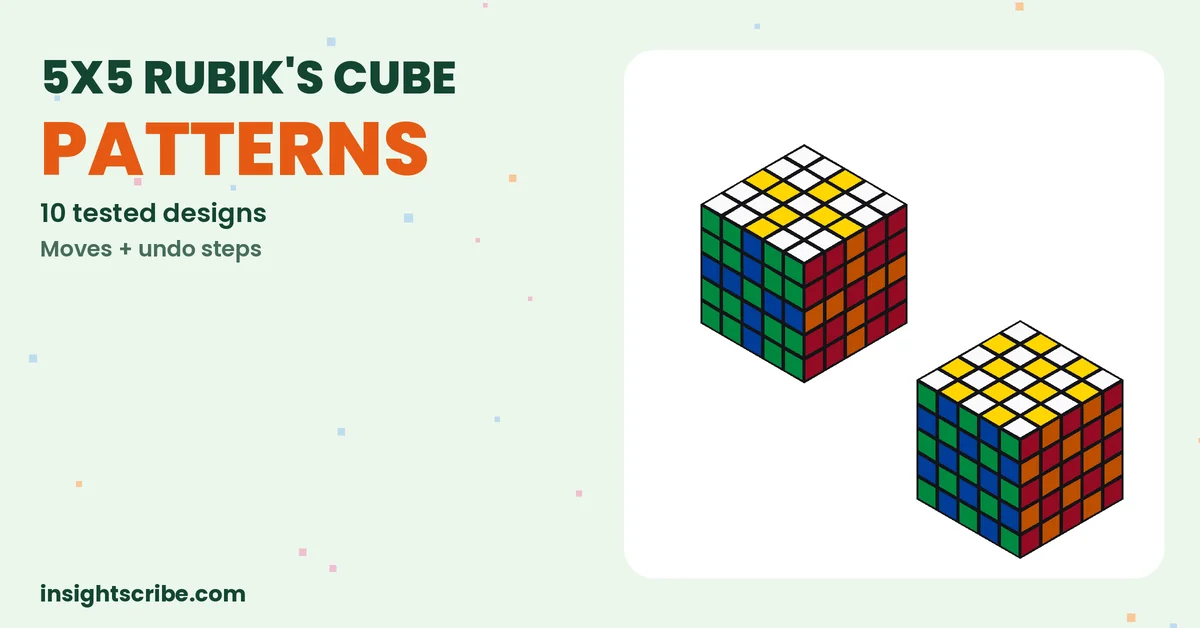
Quick answer: The easiest 5×5 Rubik’s Cube pattern is Plus signs: from a solved cube do 3Rw2 Rw2 3Uw2 Uw2 3Fw2 Fw2 (shorthand 3R2 3U2 3F2) and every face gets a plus sign. For a full checkerboard, do Rw2 R2 Lw2 L2 Uw2 U2 Dw2 D2 Fw2 F2 Bw2 B2. Below are 10 tested 5×5 patterns, each with its moves, a picture and the exact moves to undo it.
The 5×5 (often sold as the Professor’s Cube) has fixed centre squares like a 3×3, plus two extra layers on every side. That means it can show a real 25-square checkerboard, nested dots and cubes of different sizes inside each other. We ran every sequence on this page through a computer model of a 5×5, looked at the picture it makes, and confirmed that the undo moves return the cube to solved. The tables show the top, front and right faces of a standard cube held with white on top and green in front.
Key takeaways
- Start every pattern from a fully solved 5×5, white on top and green in front.
- Plus signs (6 half turns, or 3 in shorthand) is the quickest pattern that changes all six faces.
- The 3×3 checkerboard moves make a Picture frame on a 5×5. For a true checkerboard, turn the second layers instead.
- The same 3×3 moves done as outer turns or wide turns give pictures of different sizes: Big dots vs Dot in a dot, Big cube in a cube vs Cube in a cube.
- Every pattern lists undo moves that we checked on a cube model.
Contents
- 5×5 notation: outer, wide and inner layers
- All 10 patterns at a glance
- Plus signs
- Zebra stripes
- Checkerboard
- Picture frame
- Big dots
- Dot in a dot
- Dot in a crosshair
- Four windows
- Big cube in a cube
- Cube in a cube
- Why the same moves make different pictures
- Tips for clean 5×5 patterns
- FAQ
5×5 Notation: Outer, Wide and Inner Layers
The face letters are the same as on a 3×3: R (right), L (left), U (up), D (down), F (front) and B (back). A plain letter turns the outer layer on that side a quarter turn clockwise, a prime (‘) turns it counterclockwise and a 2 means a half turn. New to this? Our Rubik’s Cube notation for kids guide explains it with pictures.
Big cubes add wide turns. A small w means you turn more than one layer together: Rw turns the two right layers, and 3Rw turns the three right layers (on a 5×5 that reaches the middle). These are part of the World Cube Association’s official notation (Regulations, Article 12), which has no symbol for turning one inner layer by itself. So we write the main sequences with official moves only and build inner-layer turns from pairs:
Rw2 R2leaves only the second layer from the right half-turned. Many pattern sites write this as2R2.3Rw2 Rw2leaves only the middle layer half-turned. Shorthand:3R2.
Where a pattern has a shorter inner-layer version, we show it too. Our model confirmed that the shorthand and the official version give exactly the same cube.
All 10 Patterns at a Glance
| Pattern | Moves | Turn types |
|---|---|---|
| Plus signs | 6 | Half turns only |
| Zebra stripes | 4 | Half turns only |
| Checkerboard | 12 | Half turns only |
| Picture frame | 6 | Half turns only |
| Big dots | 8 | Quarter and half turns |
| Dot in a dot | 16 | Quarter and half turns |
| Dot in a crosshair | 22 | Quarter and half turns |
| Four windows | 10 | Quarter and half turns |
| Big cube in a cube | 17 | Quarter and half turns |
| Cube in a cube | 17 | Quarter and half turns |
A good order for beginners is Plus signs, Zebra stripes, Checkerboard and Picture frame (all half turns, so direction never matters), then Big dots, then the longer ones. If you have other cubes, try our 31 easy 3×3 Rubik’s Cube patterns and the 12 tested 2×2 patterns.
1. Plus signs
A plus sign of the opposite colour runs through the middle of all six faces.
Moves (6): 3Rw2 Rw2 3Uw2 Uw2 3Fw2 Fw2
Inner-layer shorthand: 3R2 3U2 3F2 (same result, see the notation section)
| Top (U) | Front (F) | Right (R) |
|---|---|---|
| ⬜⬜🟨⬜⬜ ⬜⬜🟨⬜⬜ 🟨🟨⬜🟨🟨 ⬜⬜🟨⬜⬜ ⬜⬜🟨⬜⬜ | 🟩🟩🟦🟩🟩 🟩🟩🟦🟩🟩 🟦🟦🟩🟦🟦 🟩🟩🟦🟩🟩 🟩🟩🟦🟩🟩 | 🟥🟥🟧🟥🟥 🟥🟥🟧🟥🟥 🟧🟧🟥🟧🟧 🟥🟥🟧🟥🟥 🟥🟥🟧🟥🟥 |
Undo: Fw2 3Fw2 Uw2 3Uw2 Rw2 3Rw2
The fastest wow on a 5×5. Each pair, such as 3Rw2 Rw2, half-turns the three right layers and then the two right layers back, so only the middle layer moves. Do that on three axes and every face gets a plus sign.
2. Zebra stripes
Four faces get five thin stripes in two alternating colours, while the left and right faces stay solid.
Moves (4): Rw2 R2 Lw2 L2
Inner-layer shorthand: 2R2 2L2 (same result, see the notation section)
| Top (U) | Front (F) | Right (R) |
|---|---|---|
| ⬜🟨⬜🟨⬜ ⬜🟨⬜🟨⬜ ⬜🟨⬜🟨⬜ ⬜🟨⬜🟨⬜ ⬜🟨⬜🟨⬜ | 🟩🟦🟩🟦🟩 🟩🟦🟩🟦🟩 🟩🟦🟩🟦🟩 🟩🟦🟩🟦🟩 🟩🟦🟩🟦🟩 | 🟥🟥🟥🟥🟥 🟥🟥🟥🟥🟥 🟥🟥🟥🟥🟥 🟥🟥🟥🟥🟥 🟥🟥🟥🟥🟥 |
Undo: L2 Lw2 R2 Rw2
Half-turning the second layer from each side flips two thin strips, so the colours alternate across the face: white, yellow, white, yellow, white on top.
3. Checkerboard
A true checkerboard of 25 squares on every face, with the corner and centre squares in the face’s own colour.
Moves (12): Rw2 R2 Lw2 L2 Uw2 U2 Dw2 D2 Fw2 F2 Bw2 B2
Inner-layer shorthand: 2R2 2L2 2U2 2D2 2F2 2B2 (same result, see the notation section)
| Top (U) | Front (F) | Right (R) |
|---|---|---|
| ⬜🟨⬜🟨⬜ 🟨⬜🟨⬜🟨 ⬜🟨⬜🟨⬜ 🟨⬜🟨⬜🟨 ⬜🟨⬜🟨⬜ | 🟩🟦🟩🟦🟩 🟦🟩🟦🟩🟦 🟩🟦🟩🟦🟩 🟦🟩🟦🟩🟦 🟩🟦🟩🟦🟩 | 🟥🟧🟥🟧🟥 🟧🟥🟧🟥🟧 🟥🟧🟥🟧🟥 🟧🟥🟧🟥🟧 🟥🟧🟥🟧🟥 |
Undo: B2 Bw2 F2 Fw2 D2 Dw2 U2 Uw2 L2 Lw2 R2 Rw2
Zebra stripes on all three axes. On a 3×3 the checkerboard turns the middle slices; on a 5×5 it is the second and fourth layers that do the work.
4. Picture frame
Each face shows a 3×3 block of its own colour inside a frame of the opposite colour, with the four corner squares matching the block.
Moves (6): R2 L2 U2 D2 F2 B2
| Top (U) | Front (F) | Right (R) |
|---|---|---|
| ⬜🟨🟨🟨⬜ 🟨⬜⬜⬜🟨 🟨⬜⬜⬜🟨 🟨⬜⬜⬜🟨 ⬜🟨🟨🟨⬜ | 🟩🟦🟦🟦🟩 🟦🟩🟩🟩🟦 🟦🟩🟩🟩🟦 🟦🟩🟩🟩🟦 🟩🟦🟦🟦🟩 | 🟥🟧🟧🟧🟥 🟧🟥🟥🟥🟧 🟧🟥🟥🟥🟧 🟧🟥🟥🟥🟧 🟥🟧🟧🟧🟥 |
Undo: B2 F2 D2 U2 L2 R2
These are the 3×3 checkerboard moves, but on a 5×5 they turn only the outer layers. The inner 3×3 block of every face stays put and the frame swaps colours around it.
5. Big dots
Every face shows a 3×3 square of one colour inside a solid border of another colour.
Moves (8): U D' R L' F B' U D'
| Top (U) | Front (F) | Right (R) |
|---|---|---|
| 🟩🟩🟩🟩🟩 🟩⬜⬜⬜🟩 🟩⬜⬜⬜🟩 🟩⬜⬜⬜🟩 🟩🟩🟩🟩🟩 | 🟥🟥🟥🟥🟥 🟥🟩🟩🟩🟥 🟥🟩🟩🟩🟥 🟥🟩🟩🟩🟥 🟥🟥🟥🟥🟥 | ⬜⬜⬜⬜⬜ ⬜🟥🟥🟥⬜ ⬜🟥🟥🟥⬜ ⬜🟥🟥🟥⬜ ⬜⬜⬜⬜⬜ |
Undo: D U' B F' L R' D U'
On a 3×3 these eight moves make a single dot on each face. On a 5×5 the outer layers move while the 3×3 centre block stays together, so the dot becomes a big square.
6. Dot in a dot
Three colours on every face: a border, a ring and a single centre square, like a target.
Moves (16): U D' R L' F B' U D' Uw Dw' Rw Lw' Fw Bw' Uw Dw'
| Top (U) | Front (F) | Right (R) |
|---|---|---|
| 🟥🟥🟥🟥🟥 🟥🟩🟩🟩🟥 🟥🟩⬜🟩🟥 🟥🟩🟩🟩🟥 🟥🟥🟥🟥🟥 | ⬜⬜⬜⬜⬜ ⬜🟥🟥🟥⬜ ⬜🟥🟩🟥⬜ ⬜🟥🟥🟥⬜ ⬜⬜⬜⬜⬜ | 🟩🟩🟩🟩🟩 🟩⬜⬜⬜🟩 🟩⬜🟥⬜🟩 🟩⬜⬜⬜🟩 🟩🟩🟩🟩🟩 |
Undo: Dw Uw' Bw Fw' Lw Rw' Dw Uw' D U' B F' L R' D U'
Do Big dots, then the same eight moves again as wide turns. The second half moves two layers at a time, which shrinks the dot inside the dot.
7. Dot in a crosshair
Up to five colours on a face: a centre dot inside a ring, crossed by lines in other colours that run out to the edges, like the crosshair on a target.
Moves (22): U D' R L' F B' U D' Uw Dw' Rw Lw' Fw Bw' Uw Dw' Lw2 Rw2 Uw2 Dw2 Bw2 Fw2
| Top (U) | Front (F) | Right (R) |
|---|---|---|
| 🟥🟥🟧🟥🟥 🟥🟩🟦🟩🟥 🟧🟦⬜🟦🟧 🟥🟩🟦🟩🟥 🟥🟥🟧🟥🟥 | ⬜⬜🟨⬜⬜ ⬜🟥🟧🟥⬜ 🟨🟧🟩🟧🟨 ⬜🟥🟧🟥⬜ ⬜⬜🟨⬜⬜ | 🟩🟩🟦🟩🟩 🟩⬜🟨⬜🟩 🟦🟨🟥🟨🟦 🟩⬜🟨⬜🟩 🟩🟩🟦🟩🟩 |
Undo: Fw2 Bw2 Dw2 Uw2 Rw2 Lw2 Dw Uw' Bw Fw' Lw Rw' Dw Uw' D U' B F' L R' D U'
Dot in a dot plus six wide half turns. At 22 moves it is the longest pattern on this page, so check the picture after the first 16 moves.
8. Four windows
Each face splits into four 2×2 blocks in two colours, separated by a cross of mixed colours through the middle, like a window with four panes.
Moves (10): Lw Rw Bw Fw Dw2 Lw Rw Bw Fw Uw2
| Top (U) | Front (F) | Right (R) |
|---|---|---|
| 🟩🟩🟧🟩🟩 🟩🟩🟧🟩🟩 🟩🟩⬜🟦🟦 🟦🟦🟥🟦🟦 🟦🟦🟥🟦🟦 | 🟥🟥🟩🟧🟧 🟥🟥🟩🟧🟧 🟨🟨🟩⬜⬜ 🟥🟥🟩🟧🟧 🟥🟥🟩🟧🟧 | ⬜⬜⬜⬜⬜ ⬜⬜⬜⬜⬜ 🟧🟧🟥🟥🟥 🟨🟨🟨🟨🟨 🟨🟨🟨🟨🟨 |
Undo: Uw2 Fw' Bw' Rw' Lw' Dw2 Fw' Bw' Rw' Lw'
Ten wide turns. Wide turns move two layers at once, so every block in the picture is two squares wide.
9. Big cube in a cube
A 4×4 block of colour sits in one corner on each face, so a smaller cube seems to sit inside the big one.
Moves (17): F U' B L U' F2 U2 F U F' U2 D' B D L2 B2 U
| Top (U) | Front (F) | Right (R) |
|---|---|---|
| 🟧🟧🟧🟧🟧 ⬜⬜⬜⬜🟧 ⬜⬜⬜⬜🟧 ⬜⬜⬜⬜🟧 🟩⬜⬜⬜🟧 | 🟧🟩🟩🟩⬜ 🟩🟩🟩🟩⬜ 🟩🟩🟩🟩⬜ 🟩🟩🟩🟩⬜ ⬜⬜⬜⬜⬜ | 🟦🟦🟦🟦🟦 🟦🟥🟥🟥🟥 🟦🟥🟥🟥🟥 🟦🟥🟥🟥🟥 🟦🟥🟥🟥🟨 |
Undo: U' B2 L2 D' B' D U2 F U' F' U2 F2 U L' B' U F'
This is the classic 3×3 cube-in-a-cube sequence. On a 5×5 it only turns outer layers, which makes the inner cube four squares wide.
10. Cube in a cube
A 3×3 block of colour sits in one corner on each face: a smaller inner cube than the previous pattern.
Moves (17): Fw Uw' Bw Lw Uw' Fw2 Uw2 Fw Uw Fw' Uw2 Dw' Bw Dw Lw2 Bw2 Uw
| Top (U) | Front (F) | Right (R) |
|---|---|---|
| 🟧🟧🟧🟧🟧 🟧🟧🟧🟧🟧 ⬜⬜⬜🟧🟧 🟩🟩⬜🟧🟧 🟩🟩⬜🟧🟧 | 🟧🟧🟩⬜⬜ 🟧🟧🟩⬜⬜ 🟩🟩🟩⬜⬜ ⬜⬜⬜⬜⬜ ⬜⬜⬜⬜⬜ | 🟦🟦🟦🟦🟦 🟦🟦🟦🟦🟦 🟦🟦🟥🟥🟥 🟦🟦🟥🟨🟨 🟦🟦🟥🟨🟨 |
Undo: Uw' Bw2 Lw2 Dw' Bw' Dw Uw2 Fw Uw' Fw' Uw2 Fw2 Uw Lw' Bw' Uw Fw'
The same 17 moves as Big cube in a cube, but every turn is wide. Moving two layers at a time changes the size of the inner cube from four squares to three.
Why the Same Moves Make Different Pictures
A 5×5 has five layers on every axis: two outer layers, two second layers and one middle layer. A pattern sequence only moves the layers it names, and everything else stays where it was. That is why one set of moves can make three different pictures depending on how many layers you turn:
- Outer turns only (such as
U D' R L' F B' U D'): the 3×3 block in the middle of each face stays together, so a 3×3 “dot” becomes a big 3×3 square. - Wide turns (such as
Uw Dw' Rw Lw'): two layers move together, so the shapes become two squares thick, as in Four windows and Cube in a cube. - Inner-layer pairs (such as
Rw2 R2): only a thin strip moves, which is how the Zebra stripes and the Checkerboard get single-square detail.
Once you see this, you can invent your own: take any 3×3 pattern you know and try it as outer turns, then as wide turns, and compare.
Tips for Clean 5×5 Patterns
- Count layers before each wide turn.
Rwis two layers and3Rwis three. Grabbing the wrong number is the most common reason a 5×5 pattern goes wrong. - Straighten every layer. Big cubes catch if a layer is left a little off. Line up each turn before the next.
- Start with half-turn patterns. The first four patterns use only half turns, so you cannot turn the wrong direction.
- Undo straight away. The undo moves only work if you have not turned anything since making the pattern.
- Hold the same way every time. White on top and green in front matches our pictures. Holding it another way gives the same shape in different colours.
You will find more cube guides in our Rubik’s puzzles collection.
5×5 Rubik’s Cube Patterns FAQ
What is the easiest 5×5 Rubik’s Cube pattern?
Plus signs. From a solved 5×5, do 3Rw2 Rw2 3Uw2 Uw2 3Fw2 Fw2 (or 3R2 3U2 3F2 in inner-layer shorthand). It is all half turns and puts a plus sign on every face.
How do you make a checkerboard on a 5×5?
Do Rw2 R2 Lw2 L2 Uw2 U2 Dw2 D2 Fw2 F2 Bw2 B2 from a solved cube. It half-turns the second layer from every side and gives a 25-square checkerboard on all six faces. The 3×3 checkerboard moves alone (R2 L2 U2 D2 F2 B2) make the Picture frame pattern instead.
Do 3×3 patterns work on a 5×5?
Many of them run, but the picture changes. The 3×3 moves turn only the outer layers of a 5×5, so a 3×3 dot becomes a 3×3 square and the 3×3 cube in a cube becomes a 4×4 block. Doing the same moves as wide turns gives yet another size.
What does 3Rw mean on a 5×5?
3Rw turns the three right layers together, which on a 5×5 is the right outer layer, the second layer and the middle layer. Rw (with no number) turns the two right layers. Pairing them, as in 3Rw2 Rw2, leaves only the middle layer turned.
How do I get my 5×5 back to solved after a pattern?
Do the undo moves listed under each pattern straight after making it. They are the pattern moves in reverse order with each turn flipped, and we checked on a cube model that every undo returns the 5×5 to solved.